A summary of the current exemptions to mandatory Biodiversity Net Gain, with specific reference to the de-minimis exemption, accompanied by a PAS advice note providing further detail on its application.
Overview
Government has laidregulations which set in motion changes to Biodiversity Net Gain (BNG)for projects requiring planning permission under the Town and Country Planning Act. These include the following changes to exemptions for planning applications made on or after 6 August 2026:
exemption for developments of sites of 0.2 hectare or less (if priority habitat is not impacted);
exemption for temporary development (if priority habitat is not impacted);
and
removal of the existing exemption for self and custom build development.
Local authority validation teams sometimes struggle to determine what evidence is needed to support the de-minimis exemption and whether the exemption is valid. The BNG PPG is helpful in setting out what is required; Paragraph: 004 Reference ID: 74-004-20240214: What development does the de-minimis exemption apply to? And how should it be assessed? and Paragraph: 010 Reference ID: 74-010-20240214:What information must an applicant submit as part of a planning application, if they believe that the statutory biodiversity gain condition does not apply to the development?
Navigating BNG, exemptions: de-minimis
In July 2025, the PAS Team shared an advice note on the de-minimis exemption, which we updated in December 2025 based on feedback. This advice note explores the use of the de-minimis exemption in planning applications, presenting a series of real-world examples drawn from both the PAS network and external sources. The document examines how the de-minimis exemption should be applied, including the difference between temporary impacts and de minimis. It aims to provide greater clarity for both applicants and planning authorities, helping them understand when the exemption is appropriate and how to apply it correctly. A key part of the note addresses four common misconceptions identified by PAS. The note concludes with a set of key takeaways and highlights pitfalls to avoid, offering practical guidance to reduce delays and improve decision-making when considering the de-minimis exemption.
Please note that this has been produced by PAS based on our work supporting local planning authorities. It is not legal or official government advice, nor is it detailed technical guidance, and it should not be relied upon in place of appropriate technical expertise.
If you require and accessible version of this document please contact [email protected]
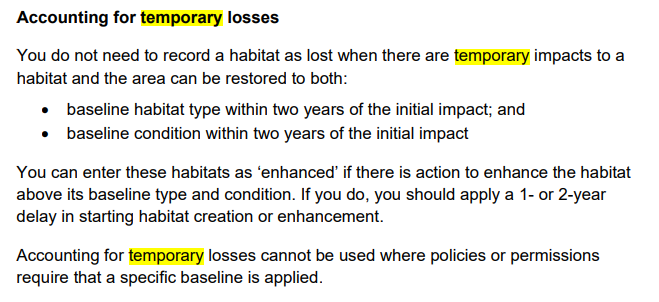
The Exemptions Regulations 2024 state that the second condition of the de-minimis exemption is that the development must affect less than 25sqm of onsite habitat with a biodiversity value greater than zero. As outlined in the advice note, based on discussions with local authority officers and taking a pragmatic approach, we have interpreted this to mean that any impact, including temporary losses on area-based habitats (with a biodiversity value greater than 0, as calculated using the statutory biodiversity metric tool) is considered relevant. The BNG PPG also highlights that the de-minimis exemption also covers development affecting a site with a value of zero. Where an impact is classed as temporary loss, page 35 of the statutory biodiversity metric user guide provides the following guidance:
The legislation itself does not refer specifically to temporary losses; it refers only to “impact” in the context of the de-minimis threshold. The PAS team understands that the metric does not indicate a loss of biodiversity value where the guidance on temporary losses, as set out in the user guide, is applied correctly. However, the legislation is explicit regarding the area threshold and makes clear that where the impact exceeds 25sqm, the de-minimis exemption cannot be applied. Temporary impacts on habitat of an area 25sqm or above are not exempted - the applicant still has to do a metric calculation, but they can apply the approach outlined for 'temporary losses' in the metric user guide if the conditions outlined there apply. We note that this is an area that continues to cause confusion, as the current guidance is not very clear on the interaction between temporary losses, definition of ‘impact’ and the de-minimis exemption.
This confusion is in part because the BNG PPG (Paragraph: 004 Reference ID: 74-004-20240214) states 'Onsite habitat is impacted by the development if it is lost or degraded such that there is a decrease in the biodiversity value of that habitat (as determined by the statutory biodiversity metric).' However, the Metric User Guide states that temporary impacts should not be counted as a loss. PAS advises a proportionate approach that any impacts, whether temporary or not, on less than 25sqm of habitat should be considered exempt.
Impact less than 25 square metres (e.g. 5m x 5m) of non-priority onsite habitat (such as modified grassland) and
Impact less than 5m for non-priority onsite linear habitats (such as native hedgerows or linear watercourse habitats).
If a development negatively impacts less than 25sqm of non-priority habitat but 5m or more of non-priority linear habitat (vice-versa) then the de-minimis exemption does not apply and the development will be subject to BNG.
Defining impact on-site
The Exemption Regulations state: 'a habitat is impacted where the habitat is lost or degraded such that there is a decrease in the biodiversity value of that habitat', so impact could be defined as any activity which may cause the loss, damage, or degradation of a habitat that could lead to a decrease in biodiversity value, as calculated using the statutory biodiversity metric tool. CIEEM’s Guidelines for Ecological Impact Assessment in the UK & Ireland emphasise that ecological impacts arise from changes that degrade environmental quality such as habitat loss. In contrast, cumulative impacts stem from actions that may seem minor on their own but may become significant if combined over time or within a specific area.
Examples of ‘impact’ may include:
Direct habitat loss i.e. removing grassland, scrub or trees for construction, paving a parking area, or even excavating part of a hedgerow to create an access point.
Structural changes i.e. soil compaction, disturbing root systems with construction works, erecting new structures which may shade out existing vegetation and fragmenting habitats.
Examples of de-minimis impact which fall under the thresholds explained above may include:
Building a small garden shed on a lawn (<25sqm).
Creating a narrow path through a wildflower meadow (<25sqm).
Removing a minor section of an existing hedgerow (<5m) to add a garden gate.
Widening a driveway slightly, affecting a small grass verge (<25sqm).
*The Small Sites Metric cannot be used if a priority habitat (excluding some hedgerows and arable field margins) is present within the RLB. This also applies to protected sites and/or protected species, if present within the RLB.
Defra’s Magic Map can help identify if a protected site falls within the RLB of the proposed development. Publicly available biodiversity data can be found through the NBN Atlas and can be used to view records of species within 0.1 - 10km of the proposed development. Please note that these records do not contain definitive biodiversity information. The absence of records may reflect a lack of survey effort in the area, rather than the actual absence of species. Local record centres may also hold information on habitats and species, although they may charge a fee for access to this service. There is also further government guidance on protected species and development.
How to indicate and evidence that a proposal is subject to de-minimis
In certain cases, to ensure a proportionate approach, evidence may be required for this exemption. For example, if site plans and descriptions do not clearly demonstrate whether an on-site habitat will be lost or degraded by the development, applicants could provide a completed metric tool showing the pre-development and post-development value of the on-site habitat. They could also submit clear plans identifying the type and area of this habitat before development, as well as how much will be impacted post-development.
This allows the relevant planning authority to verify whether the exemption applies. The authority may also choose to conduct site visits or refer to aerial mapping to assess the claim. A lack of supporting evidence for a de-minimis exemption may delay the application process.
Temporary impacts are automatically de-minimis
Temporary impacts and de-minimis are dealt with differently in the BNG system. If a development falls below the de-minimis area thresholds, it is exempt from the BNG requirement. Impact can be defined by the loss of biodiversity value as calculated within the metric tool. Temporary impacts on habitat of an area 25sqm or above are not an exemption, they are recorded in a specific way in the metric tool (see Accounting for Temporary Losses section of the Statutory Biodiversity Metric User Guide).
If the development exceeds the de-minimis threshold where more than 25sqm of habitat is impacted, even where the impact is temporary, the mandatory 10% BNG requirement applies as the de-minimis threshold is exceeded. In this case the habitats impacted temporarily should not be recorded as lost (as they are temporarily impacted and can be restored to the same baseline habitat type and condition within two years of the initial impact).
Currently, the metric tool does not include a specific feature or tab to address temporary losses. Instead, users are advised to record temporary habitat losses as ‘retained’. Users can use the comment section in each tab to detail any individual parcels of habitat proposed to be temporarily impacted. The User Guide states that if the applicant intends to enhance temporarily impacted habitat above its baseline condition and type, it should be entered into the metric tool as habitat to be enhanced, with a one- to two-year delay applied for habitat creation or enhancement. It is also worth noting that the relevant planning authority may have established policies or permissions related to temporary impacts. These should be reviewed before claiming temporary losses, as some policies may require the application of a specific baseline for certain habitat types.
Removing just one individual tree will keep you under the de-minimis threshold
Many applicants have not realised that the removal of just one tree on a development site will normally push the application over the threshold for the de-minimis exemption. When assessing trees as part of the biodiversity metric tool, it is the root protection area (RPA) and the canopy that are considered. To calculate the area equivalent of an individual tree, the User Guide encourages the use of the Tree Helper within the metric tool. Even the smallest option available equates to 41sqm, this exceeds the de-minimis threshold and so the exemption does not generally apply.
Claiming de-minimis in the presence of a watercourse
The understanding of impacts on watercourses is often simplified, with a focus primarily on direct physical encroachment to the body itself. This can sometimes overlook the need to demonstrate that biodiversity value within the watercourse and its associated riparian zone is maintained. Watercourses are classified as 'linear' features. If the development does not impact priority habitat, impacts less than 25sqm of area habitat (including the riparian zone) and impacts less than 5m of linear habitat (including the riparian zone) the de-minimis exemption applies. As with other priority habitats, priority river habitats can be identified using Natural England’s Priority River Habitat Map. The de-minimis exemption does not apply where impacts are proposed on these areas. Applicants must consider the type of watercourse, the length of the impacted section, and any associated impacts on the riparian zone before seeking to apply the exemption.
The watercourse is made up of the channel, banks and riparian zone. Any proposed works within the riparian zone would be considered as a direct impact to the waterbody. The metric tool accounts for impacts on a watercourse that occur through in-channel encroachment, encroachment within the riparian zone, or through changes in habitat condition. Where a watercourse has been culverted, the de-minimis exemption could apply, provided that the built features do not impact greater than 25sqm of non-priority area habitat and do not result in any negative impacts along the length of the culvert greater than 5m. It is also important to note that watercourses are protected by other legal frameworks, and relevant permissions would still be required for any proposed works involving waterbodies. If the metric tool is required to support a de-minimis claim, it is important that both pre-development and post-development metrics are accurately reflected in the metric tool. To complete the metric tool, the watercourse habitat must be surveyed and reviewed by an ecologist qualified to conduct river condition assessments.
Change of use applications are automatically de-minimis
A change of use planning application does not automatically qualify for the de-minimis exemption. The key consideration is whether the proposed development results in habitat loss or degradation, rather than just a change in use class. Even where no major new buildings are proposed, physical works (such as resurfacing, fencing, or vegetation clearance) can impact biodiversity. Additionally, the baseline condition of the site, including existing green space, trees or scrub must be assessed. As their removal or alteration could trigger the mandatory BNG requirement.
Operational impacts, such as increased human activity or access changes may measure as a decrease in biodiversity value. The exemption has set thresholds for habitat impact, if proposals display a change which exceed these limitations, the BNG requirement will still be enforced. Each application should therefore be assessed on its site-specific ecological impact, rather than assuming that a change of use automatically qualifies for exemption under de-minimis.
In some cases, applicants may submit applications for a change of use between broad habitats, such as from cropland to grassland. Under the current Statutory Biodiversity Metric tool (V1.0.3), one hectare of cropland-cereal crops (classified as low distinctiveness, condition assessment: N/A and low strategic significance) is valued at 2 Biodiversity Units (BUs). If the applicant proposes to enhance this area to grassland-other neutral grassland (which has medium distinctiveness, poor condition and low strategic significance), the metric tool would reflect a net gain of +1.93 BUs on-site, demonstrating an increase in biodiversity value.
If the applicant had proposed an alternative habitat type resulting in a loss rather than a gain, the de-minimis exemption would not have applied, as the proposed area would have exceeded the de-minimis threshold. Since the proposed impact in this scenario would not reduce biodiversity value but instead increase it, change of use cases where biodiversity value is enhanced do not need to claim the de-minimis exemption.
The note also provides a set of scenarios setting out applications which have claimed the exemption, each scenario details the applicant's proposal, highlights key factors determining the claim's validity, and offers guidance on navigating such cases in line with planning practice guidance (PPG). These scenarios have been carefully selected to address common concerns faced by local planning officers, with suggested approaches to help prevent similar issues in the future.
The applicant is claiming a de-minimis exemption for a site that is predominantly hardstanding, with individual trees spaced along one boundary. The applicant’s claim includes trees that would be removed as part of the proposal, yet no explanation for the de-minimis claim has been provided. No other habitat is affected.
As previously stated, a small tree (using the Tree Helper within the metric tool) is the smallest size class available for individual trees. Regardless of its low habitat value, a single small tree can still equate to 41sqm within the metric tool. Exceeding the de-minimis threshold for non-priority ‘area’ habitats (25sqm). It is the applicant’s responsibility to use the Tree Helper and provide a completed metric ensuring that this change is represented within the assessment, and that the appropriate size class and condition is selected for the relevant planning authority to verify the claim. If the claim is not fully justified and there is a lack of evidence to support, this could potentially delay the application.
Compensating for the loss of individual trees within the RLB of a development proposal can be challenging due to factors such as limited space, the time required to reach the target condition, and challenges with monitoring and enforcement. Therefore, during the initial scheme design, applicants should prioritise retaining individual trees, particularly those classified as large or very large within the metric. If trees in smaller size classes (from small to medium) are lost, it may be beneficial to source suitable replacement trees (preferably native or near-native species) of a similar size to minimise the time needed to achieve the target condition. Alternatively, enhancing existing habitat areas may be an option; however, to comply with trading rules, replacing trees on a ‘like-for-like’ basis may be more efficient.
Individual trees are often found in urban settings and on hardstanding, which may lead some developers to perceive them as having little or no value, when in fact they do have value. Trees must have a diameter greater than 7.5cm diameter at breast height (DBH) to qualify as 'small trees' in the metric. Trees smaller than this do not contribute to habitat value when assessing the de-minimis exemption threshold. When recording pre-development trees within private gardens (see section on Recording Individual Trees at Baseline in the Statutory Biodiversity Metric User Guide), all medium, large, and very large individual trees with a diameter greater than 30cm within private gardens should be recorded. This guidance makes it clear that trees with a diameter of less than 30cm should not be recorded in private gardens within the metric tool.
In some cases, an applicant may present a precise measurement of a small tree’s canopy or RPA to demonstrate that it falls below the 25sqm threshold. For instance, one application involved a self-set willow tree with a diameter slightly over 7.5 centimetres at breast height, which had developed a limited canopy due to historic management associated with its location on the boundary of an industrial unit’s engineered embankment. Where supported by clear evidence that the tree’s canopy or RPA is under 25sqm, the de-minimis exemption may be applicable. If the measurement exceeds this threshold, the exemption cannot be applied.
Other scenarios may involve cable-laying along highways/roads where the work will be temporary and the applicant may also consider the work to be de-minimis. It is important, as early as possible, to understand the route of the cabling and it can be be unclear until the work begins whether the work might impact roadside verges and trees along the length of a road. Where individual trees are present, it is impact on the RPA that must be considered and this may affect a claim of de-minimis (and also whether the impact can be considered temporary). If the impacts on roadside verges are only temporary, restoration to the original condition is completed within the two-year period, and the affected area remains below the 25sqm threshold, a de-minimis claim can be made.
However, even impact on a single individual tree (due to the RPA) can invalidate a de-minimis claim, plus the impacts on trees are not considered temporary. Consequently, the entire site within the RLB would be subject to BNG. To assess such cases accurately, a baseline assessment is necessary to determine the area of the habitat impacted, and establish whether the proposals fall within or exceed the de-minimis threshold.
The applicant could also be encouraged to revise their plans to minimise permanent impacts in specific areas, particularly if the majority of the site will only be temporarily affected and the total impacted area remains within de-minimis thresholds.
If on-site replacement is not feasible, the applicant should follow the BNG hierarchy. Additionally, if fewer than 0.25 BUs are required, the applicant is not obligated in providing evidence of having searched the off-site market for biodiversity units, in order to purchase statutory credits. However, the applicant must demonstrate compliance with the hierarchy by prioritising on-site BNG before pursuing any off-site mitigation. Suitable off-site compensation can be identified before development begins.
The applicant is proposing a small building extension onto an existing car park. They claim the de-minimis exemption, stating in the application form that the development is entirely on a sealed surface with zero biodiversity value; therefore, no biodiversity will be impacted. However, simply stating this may not be sufficient justification based on the relevant planning authority's validation requirements.
According to the PPG, if an applicant believes their proposal qualifies for the de-minimis exemption, they could state this in the application form and provide supporting reasons. Although the applicant has cited the presence of sealed surfaces as justification, the LPA may still expect basic evidence such as site plans and photographs. To confirm that the site is indeed fully sealed and that no adjacent habitat with a biodiversity value greater than zero will be impacted.
Whilst it is correct to assume that sealed surfaces and built areas are auto-assigned a value of ‘0’. The relevant planning authority may still require evidence representing this, in order to verify the claim. It is important to note that in such cases, if an exemption claim has been made, evidence may be required. Applicants could provide reasons for why their proposal meets the exemption, these reasons could at least include a description of the development, pre/post-development plans and the development’s area size in square metres.
The applicant is proposing a small outbuilding on land immediately bordering a canal. The proposed development falls within the canal's riparian zone (i.e. within 10m of the canal), as indicated by the RLB. The applicant is claiming the de-minimis exemption, stating that the outbuilding will be constructed on an area of existing hardstanding (e.g., a concrete patio or gravel area) within their property boundary. Since this surface has zero biodiversity value, the applicant argues that the construction will not result in the loss or degradation of any vegetated habitat within the riparian zone or elsewhere near the waterbody, thereby resulting in no impact.
The applicant’s justification relies on the argument that there will be no decrease in biodiversity value despite the development's location within the riparian zone. However, the relevant planning authority may still require supporting evidence. It is the applicant’s responsibility to define the area of impact and justify their de-minimis claim if the area falls below the exemption threshold. If the watercourse tab is required, then the on-site habitat should be assessed by a qualified assessor and supporting evidence must be provided by the applicant to justify the level of impact within this area adjacent to the waterbody.
If there is no impact on the waterbody and this has been proven by the applicant, there is still a requirement to assess any impacts on area habitat within the riparian zone. If impact on existing area habitat is lower than 25sqm then the exemption can be applied, if it does exceed the threshold, then the exemption cannot be claimed. The de-minimis exemption can apply to watercourses if a development does not impact a priority river habitat, affects less than 5m of linear watercourse habitat, and does not impact more than 25sqm of area habitats, including any existing area/linear habitat within the riparian zone. The User Guide identifies two types of encroachment: one for the riparian zone and another for watercourses. The watercourses tab of the metric tool evaluates these levels of encroachment and condition to determine the ecological baseline value of the watercourse habitat. Exceptions to the riparian encroachment multiplier within the watercourse tab of the metric tool may include existing features such as river crossings, small amenity features/utility units (if this is less than 5% of the riparian zone area) and/or canal/river navigation towpaths.
Exceptions to the watercourse encroachment multiplier within the watercourse tab of the metric tool may include interventions that promote natural function, processes, and the development of natural habitats as stated within the Defining Watercourse Interventions section of the User Guide. This could include e.g. woody beaver dams, soft revetment etc.
These exceptions to encroachment do not mean they are in any way exempt from BNG. For these types of exceptions, the encroachment multiplier does not need to be applied at baseline e.g. if there is an existing canal tow path which could be categorised as a major encroachment, this does not need to be applied within the metric. The applicant could still capture anything else which might fall within the riparian zone and BNG would still apply.
The applicant claims de-minimis for the garage with little reference to an adjacent field within the RLB. It is important to note that the de-minimis does not just apply to built form, it applies to the entire area within the RLB. The change of use will likely impact (decrease in biodiversity value) the adjacent field and therefore the applicant exceeds the threshold for de-minimis and does not qualify for the exemption. This is an ideal example of why applicants should provide evidence during the pre-application stage.
The simplest way to resolve cases like this is to advise the client to assess the baseline of the entire area within the RLB, as exemptions cannot be applied to specific areas within the same RLB. Section 4 of the Exemptions Regulations 2024 states that the second condition of the de-minimis exemption applies strictly to “onsite” habitat. In this context, “onsite” refers to the total area within the submitted RLB.
The proposal involves the construction of two open-sided manure storage buildings, both accessed from the same existing entrance. These structures would be positioned adjacent to each other and aligned similarly within an existing manure storage area. The submitted metric for one of the proposed buildings indicates a total site area of 1,900sqm within the RLB, including 440sqm of modified grassland (classified as low distinctiveness) in poor condition.
The remaining area consists of developed land; sealed surface. However, the application form states a total site area of 902sqm. The applicant has not provided a habitat plan illustrating post-development changes, and the submitted plans do not align with the red line boundary plan. Additionally, there has been no attempt to use the metric tool to identify post-development enhancements or new habitat creation on-site to achieve 10%.
The area of modified grassland exceeds the de-minimis threshold. The 440sqm of this habitat would experience reduced rainfall and sunlight exposure, as stored materials would limit vegetation growth. The Inspector highlighted potential indirect impacts, such as manure stores being a significant source of ammonia and a contributor to nitrogen deposition, which can threaten the growth of lower plant species and increase the risk of invasive species out-competing native species.
There are also other concerns with accuracy of the information submitted with the planning application. Applicants could ensure that all area values, particularly those relating to area sizes, are accurate and consistent throughout the application process. Additionally, the proposed scheme design layouts should align with the specifications shown in the RLB plan. Providing inaccurate layouts or inconsistent area measurements may delay the application process, potentially resulting in the relevant planning authority requesting further evidence, such as a metric, to verify an exemption claim.
The Inspector’s appeal decision noted that, although this development is not exempt, the applicant failed to provide the relevant planning authority with a pre-development baseline of the site, as well as other ecological information concerning protected species. The appeal for both applications regarding the manure storage buildings was dismissed.
The applicant has submitted a Small Sites Metric in support of the application, confirming that no trees, shrubs, or grassland will be removed to facilitate the development. The proposed landscaping plan results in a minor uplift of biodiversity units below 10% to be generated post-development. The applicant claims a de-minimis exemption, with the assessment outlining that pre-development habitats consist of 312sqm of developed land (sealed surface) and 32sqm of modified grassland, of which 21sqm will be retained i.e. 32 - 21 = 11sqm will be lost. This brings the total site area to 344sqm post-development.
The metric indicates that post-development habitats will comprise 298sqm of developed land (sealed surface) and 25sqm of vegetated garden, resulting in a minor uplift of 3.3%. In this case, the applicant is directly impacting 11sqm of modified grassland. This impact falls below the de-minimis threshold, making the exemption valid. Notably, the site layouts and the RLB remained consistent throughout the process. It is important to note that the metric was not initially required. However, since the applicant had provided one, it helped the LPA assess the exemption.
The applicant claims a de-minimis exemption, citing that the development is small in scale, with a floor space of less than 1,000sqm and a site area of less than 10,000sqm. To support this claim, the applicant submitted a Small Sites Metric outlining a pre-development metric with a total site area of 360sqm. This comprised 46sqm of developed land; sealed surface, 275sqm of modified grassland, and 39sqm of artificial unvegetated; unsealed surface.
The proposal included enhancing 212sqm of modified grassland to good condition, while 63sqm of this same habitat was recorded as lost. Since the direct impact (habitat loss) exceeds 25sqm, the de-minimis exemption does not apply in this case. The metric also indicated that at least one small tree would be planted on-site post-development. Despite the metric suggesting an uplift of 15.44%, discrepancies were identified within the submitted evidence.
The preliminary ecological appraisal presented conflicting figures and post-development changes compared to those in the metric. The appraisal reported 40sqm of developed land; sealed surface, 39sqm of artificial unvegetated; unsealed surface, and 203sqm of other neutral grassland in good condition. The post-development figures stated that all 203sqm of this neutral grassland would be lost, with no mention of planting a small individual tree.
This inconsistency understandably caused confusion for the relevant planning authority and created an unfair burden on the external consultant. This example illustrates that some level of ‘tampering’ with the metric may have occurred before submission to the LPA. Such discrepancies contribute to delays in the application process.
To prevent such issues, applicants should provide consistent information across all documents (especially the application form) requiring area specifications and include a clear proposal outlining both pre/post-development metrics. It is likely that the LPA discussed these concerns with the applicant, who have since withdrawn their application for this proposal.
Although the structure is temporary, it would not be classified as a temporary impact due to the period of time this structure is intended to be set up for. The grassland could be restored in the future, but the area still exceeds 25sqm and does not qualify for the de-minimis exemption.
This planning application relates to a grassland habitat of low distinctiveness, currently registered as agricultural land. The site is occasionally grazed and has been used for car boot sales for several years under permitted development. Existing bare ground is already present in parts of the site due to vehicle use and the placement of temporary facilities such as portable toilets. Although no permanent development is proposed, the application seeks permission for a temporary change of use to increase the number of events taking place during 2024 and 2025.
While no permanent structures are included in the proposal, an increase in vehicle movements and site setup for the car boot sale is anticipated. The area expected to be affected by vehicle access and temporary installations exceeds the 25sqm threshold. The applicant has highlighted that this land forms part of a wider land management rotation across 16 fields and may be used for grazing or ploughing as part of this cycle.
The relevant planning authority may consider impacts in terms of any potential change to the distinctiveness or condition of the existing habitat. Where the proposed use is likely to result in a deterioration of condition, the LPA will assess whether this can reasonably be restored within a two-year period. If the habitat is already in poor condition, additional disturbance may not lead to a significant change. Unless the activity results in vegetation loss and leaving bare ground. In such cases, where temporary impacts are claimed, the applicant would need to provide appropriate justification that restoration to the original condition is feasible within two years.
For habitats of higher distinctiveness, repeated disturbance followed by restoration within this timeframe may not be considered achievable. Although the applicant may indicate that the land will return to its original agricultural use and that the effects are temporary, the area affected by vehicles and other activities exceeds the 25sqm threshold. Therefore, the de-minimis exemption does not apply in this case.
This application concerns a small campsite located on land that appears to be in agricultural use. The applicant is seeking a change of use and has indicated that the impacts will be temporary, with a claim for the de-minimis exemption. It is noted that while the area footprint of both individual tents and timber toilet structures fall below the 25sqm threshold, the total area across which tents may be pitched exceeds this limit.
Although individual tents are temporary in nature, the change of use to a campsite may give rise to broader and potentially longer-term ecological impacts. As such, it may not be regarded as a simple, short-term or seasonal use in ecological terms. There are also relevant considerations around the extension of temporary permissions and delivery of BNG.
As outlined in the previous case of car boot sales, to qualify as a temporary impact, the applicant would need to demonstrate that any loss in habitat condition or distinctiveness can be reversed within a two-year period. It is for the relevant planning authority to determine whether restoration to the original state is realistic and achievable within this timeframe.
While the applicant may assert that the impact is both temporary and limited to less than 25sqm, the nature of a campsite means that campers are typically free to choose where to pitch their tents. This flexibility can result in a wider area being affected over time, without a fixed impact footprint. Consequently, the cumulative area of disturbance may exceed the 25sqm threshold, even where individual elements remain below the de-minimis threshold.
It is the applicant’s responsibility to provide clear and reasonable justification that the area impacted will remain below the threshold. If the planning authority is not satisfied with the evidence presented, the de-minimis exemption may not be considered applicable.
The panels will indirectly impact the habitat underneath over time, preventing any sunlight from reaching the land beneath. The total area of this solar array exceeded 25sqm, so de-minimis does not apply. The applicant also stated that the loss of grassland for burying and installing cables would be a temporary impact. However, since this impact is concentrated within an area which exceeds 25sqm, de-minimis still does not apply.
Solar Energy UK’s (SEUK) Natural Capital Best Practice Guidance recommends that sites proposed for solar farms should be assessed on a case-by-case basis. If it is demonstrated with evidence that mitigating impacts onsite within the RLB is not possible, the applicant should offset the impact elsewhere. This can be achieved by purchasing off-site biodiversity units from a registered gain site. The guidance offers examples of ecological enhancements that can be delivered on solar farms, particularly through broad habitat types such as grassland, individual trees, hedgerows, orchards, scrub and more. A study commissioned by SEUK [16] on ecological trends at solar farms in the UK found that solar farms have significant potential to generate biodiversity uplifts, as they are often located on intensively managed agricultural land.
The study references a specific case where biodiversity assessments conducted on ten ground-mounted solar farm sites revealed that measures could be implemented to increase biodiversity value on-site alone across all ten locations.
The issue of underground works, such as drilling and excavation for cabling and their interaction with the de-minimis exemption and temporary impacts is a common one. If there is no reasonable opportunity or justification for delivering BNG on-site, applicants should seek off-site alternatives.
Where an applicant proposes an alternative off-site area on land they also own, it is worth establishing whether this land can be used to secure BNG for the required minimum term of 30 years. For instance, a solar farm application may involve the installation of a cable route using direct drilling beneath existing hedgerows or streams, and near a local wildlife site. Although the applicant may claim only temporary impacts, the proposal may impact a waterbody, disrupt the root systems of hedgerows, and/or potentially cause unknown impacts on the designated site. As such, it may not meet the criteria for either a temporary impact or the de-minimis exemption.
For this specific case, the applicant proposes the use of land outside the RLB but within the blue line boundary. However, the relevant planning authority has identified this area as an easement for a gas pipeline. This raises concerns, as the presence of utility infrastructure suggests that future disturbance is likely, and any proposed habitat enhancements may be compromised. Given that the target condition proposed is high, it may be more appropriate for the applicant to suggest a more realistic, lower target condition due to the absence of long-term ecological stability.
In certain cases, underground cabling may be classified as having a temporary impact, particularly due to access requirements for the power network. For gas pipelines, applicants may be required to keep the area clear of trees, not necessarily for access, but because of concerns around root depth. In such instances, shallow-rooted hedgerows may be considered acceptable. Some planning authorities may also incorporate a clause into the relevant legal agreement, allowing time for any remedial works related to power lines within the RLB to be completed without compromising long-term BNG commitments.
A biodiversity metric and accompanying ecological information submitted with a planning application should clearly identify any potential impacts. Where temporary impacts are claimed, these should be supported by appropriate evidence and informed professional judgement. This is particularly important when the proposal is expected to temporarily impact any habitat, as robust justification is required to support such a claim. It remains the responsibility of the relevant planning authority to determine, based on the information provided, whether the impacts can be considered temporary.
The applicant is claiming an exemption based on less than 5m of linear habitat being impacted, as the proposed impact is approximately 4m in length. To support this claim, the applicant has provided photographs to the relevant planning authority.
The images show that access will be created between two mature trees. The proposal clearly falls within the RPAs of both trees, and even if they are retained, the planning authority may assume there will be a cumulative impact on them over time.
In this scenario, it may be beneficial to request further details on how the applicant plans to retain and protect these trees, including the surrounding land. For example, they could confirm whether they will avoid laying hardstanding or sealed surfaces and whether certain equipment will be restricted in this area. The relevant planning authority could make this subject to a planning condition, issue an informative, or advise the applicant that proceeding with works beyond the claimed exemption could result in a breach of planning conditions.
The de-minimis exemption and temporary impacts are distinct considerations. It is essential to understand that these are separate concepts. The fact that an impact is temporary does not automatically qualify it for a de-minimis exemption.
The Statutory Biodiversity Metric or Small Sites Metric assessment is still required for temporary impacts on habitat of an area above 25sqm. For temporary impacts, the metric should demonstrate that the impacted habitat can be restored to its baseline condition within the two-year timeframe (it does not need to be recorded as ‘lost’ and can instead be recorded as retained or even enhanced if there is intention to achieve a better condition).
The top 3 most common pitfalls to avoid with the de-minimis exemption include:
Assuming automatic exemption via de-minimis based on temporary impacts.
Ignoring area thresholds. Impacts must be below the specified thresholds to claim de-minimis.
Not providing evidence/justification. Applicants should not assume that the relevant planning authority will accept a de-minimis claim without sufficient evidence.
If you're looking to explore how mandatory BNG works and how the system operates, a valuable resource is the guide published by CIEEM, IEMA, and CIRIA on mandatory BNG in England. This document provides clear, step-by-step guidance on what actions to take, when to take them, and why they are essential for your scheme design. It also highlights best practice, particularly regarding the information that should be included at the initial submission stage of the planning application process. Referring to this guide can help ensure compliance and a smooth application process.
DISCLAIMER:The PAS team updates these pages regularly to reflect current guidance on biodiversity net gain as best we can. Our goal is to provide accurate, timely information to support local planning authorities. If you are from a local authority and have any questions about the content or need further information, please contact us at [email protected]. This page was last updated on 14/07/25.