PAS is providing ongoing support and resources to help Local Planning Authorities (LPAs) implement mandatory Biodiversity Net Gain (BNG) under the Environment Act 2021. This page provides an overview of the recent government response to BNG for NSIPs and its upcoming implementation.
Biodiversity net gain latest (April 2026)
DEFRA have published a blog on: Biodiversity Net Gain: what’s changing and what it means for you – Environment confirming that the 10% BNG requirement will apply to NSIPs, or components of NSIPs, onshore in England, as far as the mean low-water mark from November 2026.
You can access the full government response here. It includes updated model text for biodiversity gain statements (‘model text’) in annex 1, setting out the final policy approach for all NSIP types. The response confirms that final biodiversity gain statements containing this model text will be published in May 2026 – one for each National Policy Statement (NPS), and one for NSIPs without an NPS.
Mandatory BNG will apply to DCO applications submitted from 2nd November 2026 onwards. For DCO applications submitted before then, mandatory BNG will not apply - this includes any changes made to the DCO after the implementation date. The implementation date has been adjusted to allow sufficient time for developers to integrate the final BNG framework into NSIP proposals and for decision makers to prepare for the mandatory approach. To accompany the legislative changes, DEFRA will provide supporting guidance and update the statutory biodiversity metric user guide for NSIPs ahead of go-live.
Some National Policy statements encourage voluntary delivery of BNG and applications should still refer to these for applications being submitted before 2nd November e.g. see section 4.6.6 on Applicant Assessment of the Overarching National Policy Statement for Energy (EN-1) (December 2025). The PAS team have created a dedicated page on NPS across different sectors. Defra recognises the need to ensure LPAs have sufficient resource and funding to carry out their role on BNG for NSIPs effectively and to prevent delays. Government will provide support to LPAs to prepare them for mandatory BNG for NSIPs. In partnership with PAS, Defra will be developing resources to help LPAs in their role in BNG for NSIPs.
Government has funded LPAs to implement mandatory BNG from 2021/22 to 2026/27. LPAs may choose to use this funding to help prepare for their involvement in BNG for any upcoming NSIPs in their areas, including investing in staff skills or processes for monitoring and compliance. LPAs can currently recover costs for their involvement in the DCO process through PPAs with applicants, and MHCLG are working to bring in statutory backing for LPAs to charge to ensure full cost recovery, which is due to come into effect in Spring–Summer 2026.
BNG for NSIPs consultation response
This recording provides a high-level overview of the Government's response to the May 2025 consultation on BNG for Nationally Significant Infrastructure Projects (NSIPs).
The NSIP process
The role of LPAs in the BNG process for NSIPs is different to that of TCPA developments, reflecting the different consenting regimes. To find out more about the stages of the Development Consent Order (DCO) process for NSIPs and the role of LPAs in this system, you can access our page to run through the key stages of the DCO process. The government response has already set out a handy flow chart of how BNG will apply to the different stages.
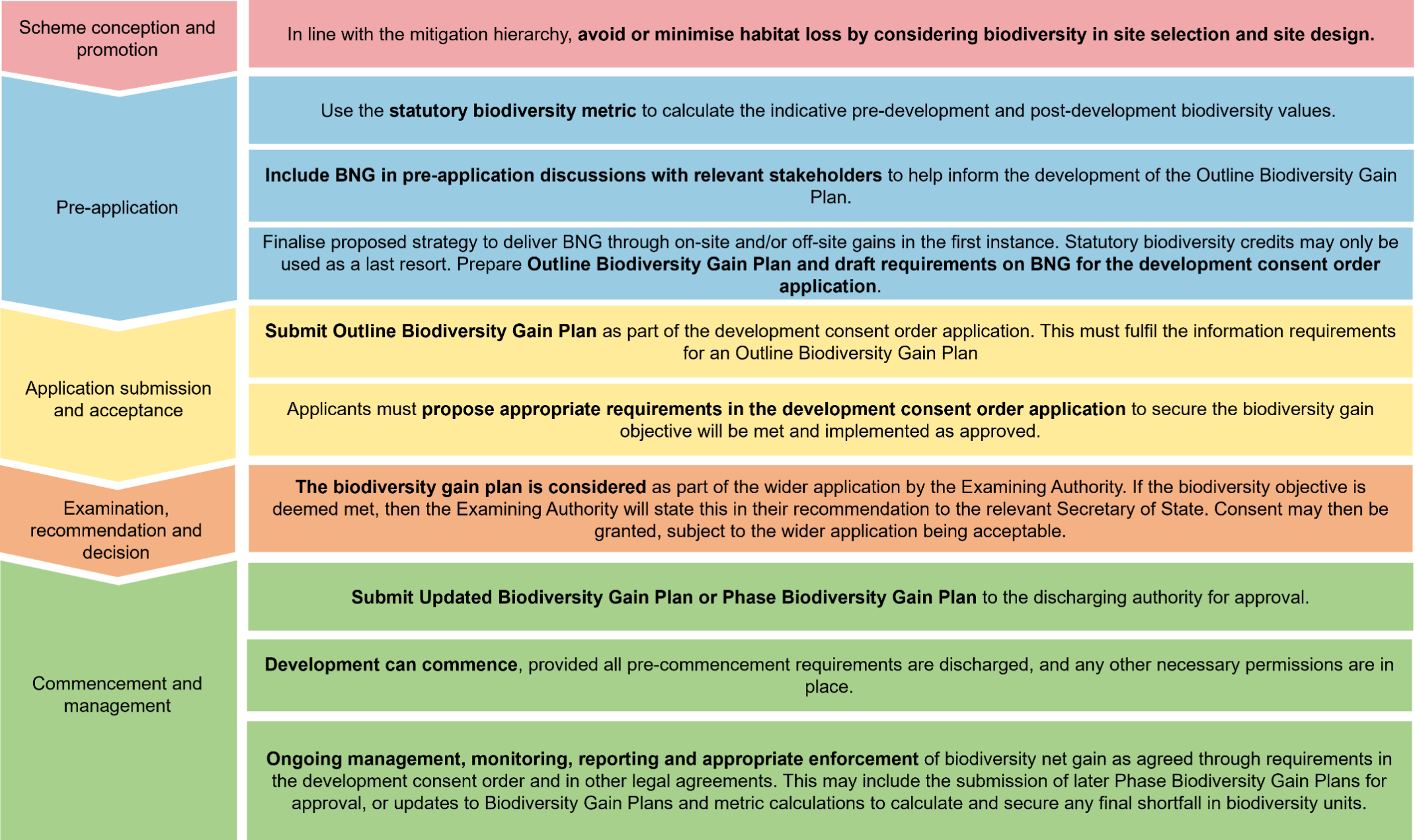
The response emphasises the importance of considering the mitigation hierarchy from the outset, so although the applicant can choose to deliver on-site or off-site in the first instance, the mitigation hierarchy must still be followed. There also a number of additional considerations to be aware of, including;
- Excess gains because of (NSIP) development can be used as off-site units for other development applications.
- There are provisions in the Environment Act 2021 to allow Marine Net Gain to be made mandatory for NSIPs in the future. Defra will provide further information on the development of Marine Net Gain in due course. Natural England published a report on the Marine Net Gain Assessment Frameworks in January 2026.
- DEFRA has decided to apply a consistent BNG requirement across all NSIP types without exemptions or voluntary approaches.
The PAS Team have been working closely with officers and MHCLG on understanding the issues pertaining to the red-line boundary with TCPA applications. For NSIPs, the government has confirmed that BNG will apply to areas within the ‘BNG boundary’ rather than the whole order limits. This new BNG boundary must include all areas of habitat within the order limits that will either be negatively impacted (both temporary and permanent impacts) or will be enhanced or have habitat created on to contribute towards the development’s BNG.
The response also confirms that temporary impacts to habitats are still included in the baseline and subject to 10% BNG. However, it introduces some flexibilities on temporary impacts for NSIPs. It clarifies that habitats that are impacted temporarily and reinstated to the previous habitat type and condition can count towards BNG without being secured (i.e. they are considered non-significant gains). It also introduces an extension to the temporary loss function in the metric for NSIPs.
The response confirms that existing process and government guidance on compulsory acquisition should be applied: Planning Act 2008: procedures for the compulsory acquisition of land - GOV.UK .
Defra has revised the model text to clarify that habitat value should be assessed at the time of submission of the biodiversity gain plan, rather than submission of the Development Consent Order (DCO) application.
There will also be flexibility on who can act as the discharging authority for post-consent gain plans, this could be the host authority, the lead authority or the SoS (in consultation with relevant authorities) for projects spanning multiple authorities. In terms of submission evidence, please refer to DEFRA’s flow chart above to identify when the outline or phase gain plan should be submitted.
DISCLAIMER: The PAS team updates these pages regularly to reflect current guidance on biodiversity net gain as best we can. Our goal is to provide accurate, timely information to support local planning authorities. If you are from a local authority and have any questions about the content or need further information, please contact us at [email protected]. This page was last updated on 11/05/26.