Following initial research in 2022 we undertook another round of research in Spring 2025 to better understand the barriers to and opportunities for action by local authorities on nature recovery with a focus on: a. the key conditions that enable action, b. understanding and engagement by senior management and members and c. the relationship between local authorities and Natural England. Last updated 6th November 2025.
1. Acknowledgements
We are grateful to the local authority officers who participated in these conversations for their time and expertise. The officers contributed their own opinions, based on experience, and these are not necessarily the formal views of their authority. We would also like to sincerely thank the ADEPT Natural Capital and Heritage Group, Solace and UK100 for their input.
Special thanks to Professor Alister Scott, Professor of Environmental Geography and Planning, University of Northumbria, who contributed to the research.
2. Executive Summary
These findings and insights are the output of research undertaken between autumn 2024 and Spring 2025 to better understand the barriers to and opportunities for action by local authorities on nature recovery, with a focus on:
a. the key conditions that enable action, b. understanding and engagement by senior management and members, and c. the relationship between local authorities and Natural England.
When we talk about action on nature recovery, we are referring to a wide range of activities that could be classed as delivering benefits for nature, from strategies and partnership working to plans and policies to projects and delivery on the ground.
The aim of this research is to capture the local authority perspective to ensure the focus of the Natural England-PAS Nature Recovery Project going forward is on delivering support that is of the most help to local authorities. It is also intended to help Natural England better understand the local authority perspective and, therefore, how they might work more effectively with local authorities to deliver nature recovery together. It is set in the context of a time of significant change for local authorities, planning, and the way that Natural England works, all of which create additional barriers but also opportunities for action on nature recovery.
1. These findings and insights are based on desk-based research; interviews with key stakeholders; survey and structured interviews with 18 local planning authorities ranging in size, location and type (i.e. combined authorities, county councils, unitary authorities and district councils); interviews with Natural England staff involved in planning; insights from PAS events, including interim presentations of these research findings, and our wider work programme; and workshops with ADEPT and National Park Authorities.
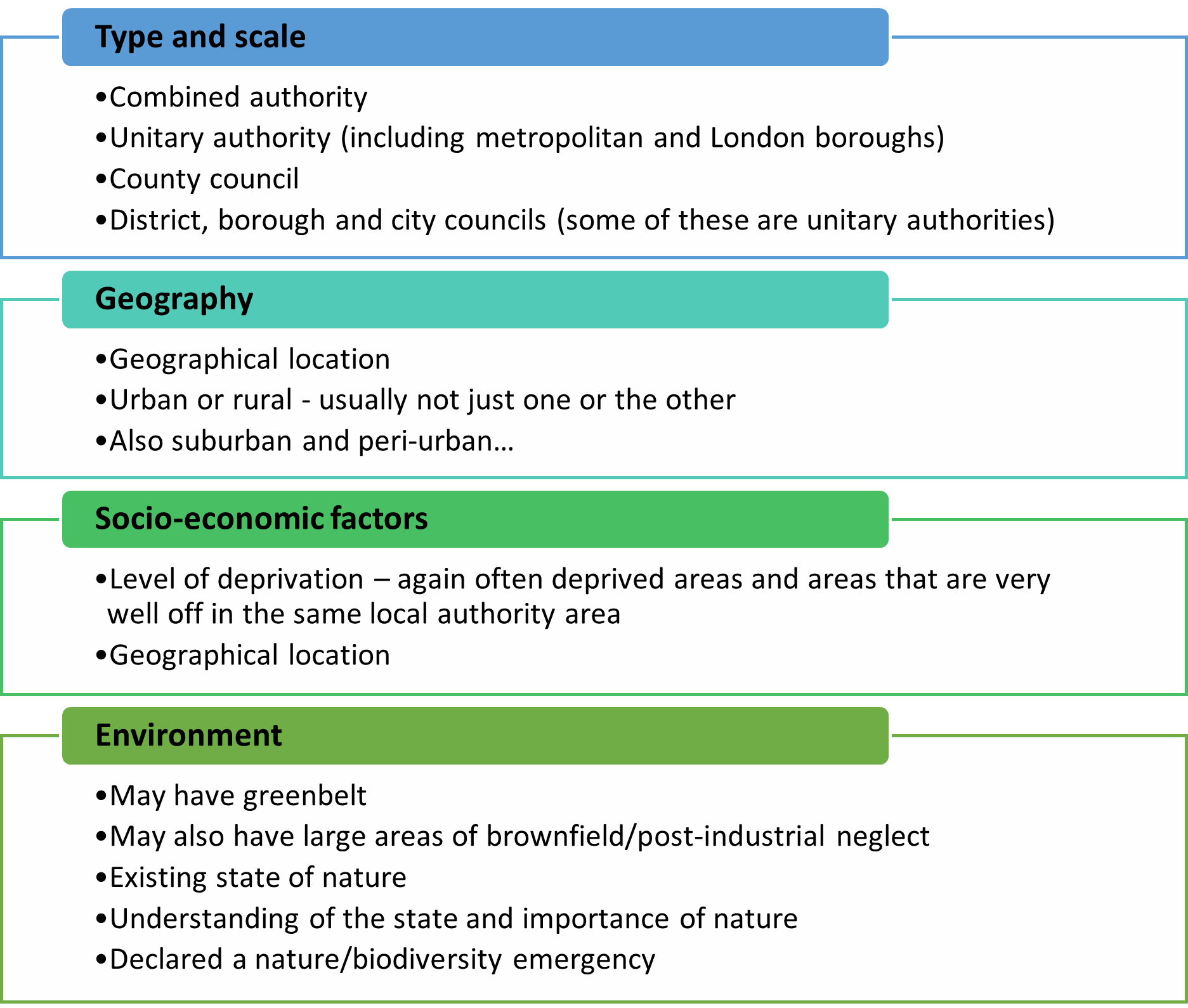
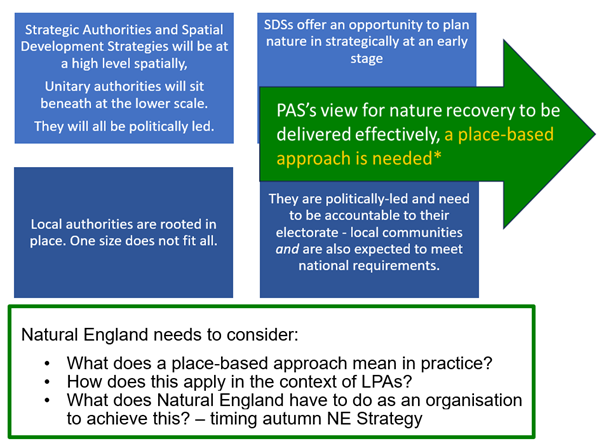
2. There are currently 317 local authorities in England with huge differences around how each one works, their priorities and therefore whether and how they engage and act on nature recovery. All are politically led and need to be accountable to their electorate, local communities and to meet national requirements. This variety means that a ‘one size fits all’ approach to working with local authorities is not the most effective, and a customer-focused, place-based approach will work best. This rationale is explored further in these findings and insights.
3. We have framed our research around a continuum of action for nature by local authorities from ‘weak’ to ‘good’, with consideration given to how we can help ‘nudge’ local authorities along.
4. Our key insights on the barriers and opportunities for action by local authorities on nature recovery are:
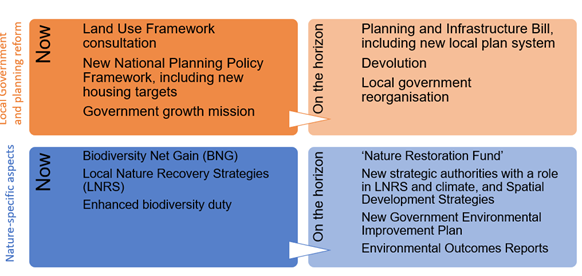
5. Many of the challenges and barriers local authorities are dealing with are common with Natural England, and working together more effectively to address these, learning from those places that already do this well, would be hugely beneficial. Natural England has an opportunity to reframe their relationship with local authorities with the changes brought about by local government reorganisation, devolution, the Planning and Infrastructure Bill and a new National Planning Policy Framework (NPPF). There will be fewer local authorities, which will make it easier for Natural England to engage in the future, but a place-based approach will still be needed.
6. The changes coming will mean that engagement and action by local authorities on nature recovery will be challenging over the next few years, as they focus on extensive restructures, mergers, and transformation. These challenges will particularly limit opportunities to engage with local authority senior managers and members, but also mean that the drive for collaboration and working together is even greater.
7. We have set out recommendations for PAS to take forward as part of this project going into 2025-26, alongside how Natural England could work better with local authorities.
3. Summary of the Project
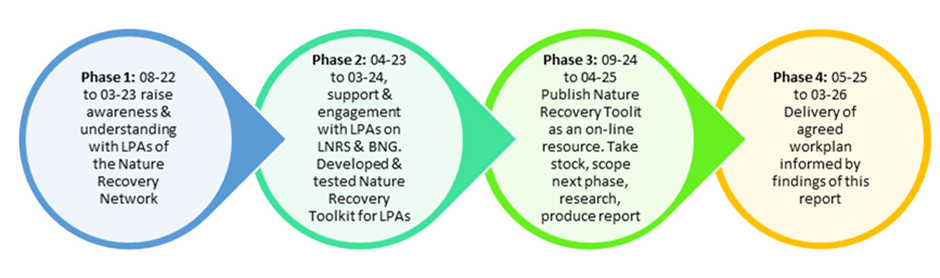
Natural England has been working with PAS on the Nature Recovery Project since 2022.
Following a short hiatus between March and September 2024, PAS took the opportunity to take stock and scope out what was needed for the next phase of the project, taking into account:
- It’s a busy world for local authorities - planning reform, new Government, etc.
- PAS has space to think about these issues, but local planning authorities (LPAs) don’t – planning services are dealing with a multitude of issues!
From September to November 2024, PAS scoped out the next steps. On 14th November 2024, a workshop was held with key Natural England (NE) staff to agree on what is reasonable and deliverable for the project. A survey and video setting the context were sent ahead of the workshop.
By the end of the workshop, it was agreed to dive deeper and undertake further research to capture the local authority perspective and assist with NE’s understanding of where local authorities are, what their issues are and therefore how NE might most effectively support them. These findings are the product of the subsequent research, with further details can be found in Section 7 Research Approach.

4. Context, Drivers, and Opportunities
There are currently 317 councils/ local planning authorities (LPAs) in England. They undertake a vast range of services from adult social care to biodiversity net gain. Most are statutory duties, i.e. duties local authorities have to legally perform. 1,294 statutory duties were identified in a review of the statutory duties placed on local government. They also own and manage land such as parks and open spaces, from allotments and cemeteries to parks and local nature reserves.
Many of the nature-associated statutory functions are linked to planning – hence why planning is a key ‘hook’ for nature recovery action by local authorities.
Though most new duties come with ‘burdens funding’ for local authorities, most others, including their biodiversity duty under the Natural Environment and Rural Communities (NERC) Act, get no direct funding from central government.
There are many other functions, programmes, and projects that local authorities undertake for nature recovery that are not statutory; our research identified some great examples.
In some areas, these non-statutory functions, programmes and projects will be vulnerable to ‘cuts’ when budgets get tight or political priorities change, which explains in part why there is such a range in capability and capacity to deliver for nature amongst local authorities.
5. The Key Conditions that Enable Action for Nature
As part of the scoping work for this research, we identified three key conditions for local authorities to take action for nature:
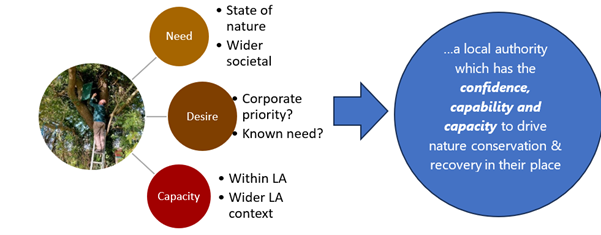
Through our interviews and wider research, we wanted to understand the wide spectrum across all these conditions amongst local authorities and what that means for taking action, including whether and how local authorities can achieve something even when they don’t have all of these ‘conditions.’
Capability and Capacity
![Natural England’s Planning Casework list of statistics [Source Natural England Stakeholder workshop May 2025 ‘Planning Reform: Opportunities and Risks for Nature Recovery and Economic Growth’]](/sites/default/files/images/NE%20%26%20Planning.png)