
Introduction
Overview
The front door to adult social care (ASC) is often under pressure and unable to help all who present.
Councils who take ownership of organising a comprehensive, complementary offer from the voluntary, community, faith and social enterprise (VCFSE) sector benefit not only their residents but also the efficient and effective working of their front door.
This report proposes a simple straightforward system model which details the necessary steps to offering useful alternative provision.
The model identifies important layers of organisation and principles. These are not only around key values (strength-based, co-produced, empowering people) but also working approaches (shared data, building networks, developing over time) that need to be in place to create a good quality alternative offer to run alongside the traditional front door.
The work is based on previous successful existing alternative provision and working with councils to identify missing elements before they are able to offer a such provision.
Case for change
Within all communities, adults of all ages are living with disabilities, physical and mental health needs. We are also an aging population that are living with disability and illness much longer now than in previous decades. We know that, with help, people can live fulfilling and independent lives outside of a formal care setting. Achieving this often involves support from the VCFSE sector.
This report explores the positive steps that councils can take to facilitate this and introduces a model that describes necessary steps and preconditions for this to be successful.
What do we mean by the front door to adult social care?
In the context of adult social care, the term ‘front door’ refers to the initial point of contact that councils have in place to respond to inquiries or concerns related to adults who may require support social care services. When someone reaches out for help, whether it’s a professional, an individual or a concerned member of the public, the front door is where the process begins.
Getting the front door right significantly impacts individuals in both the short and long term, making it a critical component of adult social care services. Often people try to access adult social care at a point of crisis or new period of needing support. Many enquiries can be dealt with by wider VCFSE stakeholders, before moving to being considered under statutory adult social care eligibility.
What is a usual adult social care front door model?
Provision varies across the country but often the ‘front door’ will be where an individual’s needs are assessed using statutory criteria under the guidance of social work professionals. If they meet these criteria, then they will be eligible for assessment and support.
The current system as it stands in many councils may not be an optimal use of resources or lead to the best outcomes for all who draw on social care. If someone is lonely and isolated, they may not be entitled to statutory social care services, but still have a need for support. If someone meets the criteria for social care but would rather remain independent and within their community, it may be that a more personalised community offer would be preferable. This both improves social outcomes for individuals and conserves resource so that it can be targeted at those who are most in need.
What would be the value of expanding the front door offer to encompass a comprehensive complementary VCFSE service?
Using different types of front doors means that residents can use the best and most accessible way to ask for help, whether that be via a community centre, over the telephone, on the internet or through referral from a professional or as part of a hospital discharge.
It enables a conversational approach to establishing what the need is, and routing people to VCFSE support in a timely and coordinated way, by triaging those presenting with a need, to a coordinated network of VCFSE support, without a long waiting time and avoids escalation up to social workers, unless required.
Those who have needs, but who do not meet statutory eligibility, can be supported through alternative non-statutory provision. In many cases this alternative provision can prevent, delay or eradicate the need for individuals progressing to requiring statutory support and, if by strength-based approaches, build strong, informal support circles within the community.
A different approach to the front door: the community coordinated approach
“A Community Coordinated Approach to supporting the front door model for adult social care (ASC) aims to facilitate a holistic approach to co-producing a good life well-lived in a flourishing community. It emphasises resident involvement, defines service delivery through ‘enabling help’ (McKeith, 2021), establishes networks of support and co-governance with the VCFSE, and operates on a set of principles. Crucially, the model prioritises people by placing them at the centre of a newly designed, systemic, place-based ecosystem approach.”
In practice it enables access to wider assets and supports within a place by creating a coordinated VCFSE access system that deals with multiple needs simultaneously, whilst maintaining established access routes. It functions as a way of coordinating access into a wide range of VCFSE support and activity.
Community coordination allows for dedicated and focussed resources to nurture engagement and involvement, stimulating resident led action, for example, ABCD. Part of its success relies upon systems to enable collaborative working across multiple VCFSE at operational and decision-making levels.
A community coordinated approach to supporting the front door model goes further than current models by:
- harnessing the full value of the assets in a place and nurturing the growth of these assets, by reaching, engaging and involving the people, who would traditionally draw on adult social care, as part of the solution.
- ensuring that there is ‘enabling help’ to support people to identify their own resolutions and draw in wider support as required.
- drawing on wider support and specialisms only as required and for as long as they are required.
- creating the mechanisms to redirect people to these VCFSE offerings simultaneously, which in turn, reduces demand on adult social care statutory front door and to allow existing resources to be best targeted.
- nurturing a more strength-based, co-productive and collaborative culture.
- Developing this approach and way of working results in a stronger collaborative VCFSE offering that is more sustainable and more impactful. The approach is supported by the integrated care system (ICS).
The community coordinated approach to supporting the front door model for adult social care
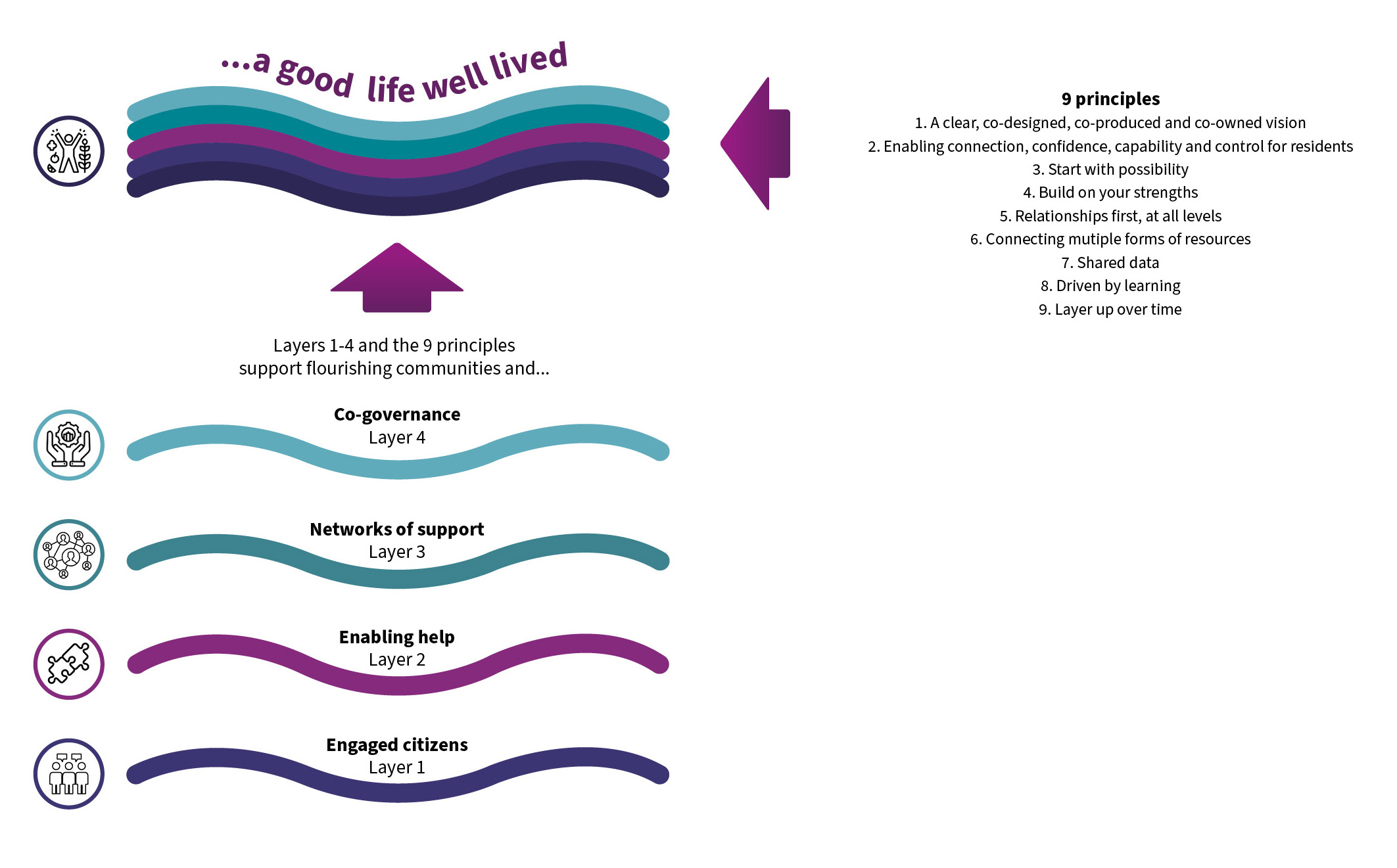
Four layers
Each layer builds upon the previous one, creating a strong, interconnected system that supports a thriving, flourishing community, with all layers interconnecting, to nurture a good life, well lived.
- Layer one: This is the foundation, focusing on strengths or asset-based practice. It focuses on reaching people in all corners of communities, engaging and connecting people, fostering confidence, capability & a sense of control, catalysing community-led activities, and development.
- Layer two: Here, we connect services to the community and individuals to specialists when needed. This layer is characterised by relational, flexible, and contextual practices, drawing in specialisms, as required, connected via shared systems with a variety of different entry points to ensure equity of access.
- Layer three: This layer is about forming networks of support that bring together people and organisations with a shared purpose and intent. It nurtures joint working, is resourced to work effectively, and encourages sign-up and involvement.
- Layer four: Building on the previous layers, this is the co-governance layer or a network of networks. It enables the layered ecosystem to function effectively, to learn, adapt, and grow, supporting everyone to lead the best life possible.
Underpinning these layers are the principles that that guide the layered model.
Nine principles
The work of Hilary Cottam lends itself to this model. Cottam`s influential book, Radical Help – How We Can Remake the Relationships Between Us and Revolutionise the Welfare State, published in 2018, articulates a different way of being and working. This approach seems better suited to our time than the welfare state constructed more than 70 years ago. Her principles are established and inspired our nine principles to support this model.
- a clear, co-designed, co-produced and co-owned vision
- enabling connection, confidence, capability and control for residents
- start with possibility
- build on your strengths
- relationships first at all levels
- connect multiple forms of resources
- shared data
- driven by learning
- layer up over time.
Conclusion
This report highlights the opportunity for councils to work with the wider community to re-orientate approaches to community-based social care. This approach supports councils to maximise use of the assets and strengths from across their system and from their communities.
There is value in building social capital and a sense of community not just for community health but also to promote and maintain the health and independence of individuals. Councils and their partners play a key role in supporting this development.
The model will be offered as a resource for councils to assess their engagement with non-statutory community- based assets to maximise their ability to meet the needs of all living within their communities. This approach allows the promotion of independence and wellbeing of individuals, whilst conserving limited resources for appropriate and targeted use.