
Introduction
We are more than 1.52 million strong.
We work together so we can all live gloriously ordinary lives.
We are adult social care.
It's the little things that matter - making sure people feel connected and considered.”
Workshop participant, December 2024
There is now a high level of consensus across the sector about the vision for the future of care and support in England. A fair system that enables us all “to live in the place we call home, with the people and things that we love, in communities where we look out for one another, doing what matters to us” (Social Care Future).
The adult social care (ASC) workforce and the people they support are at the centre of everything that is adult social care. From people directly employed by those they support, to care workers supporting people in care homes, day support, social care teams, bespoke community support, advocacy support and more. Through commissioning social care, councils play a key role in a sustainable health and care system.
Whether we realise it or not, adult social care affects us all. At its best it provides care, support and safeguards, enabling people to live “gloriously ordinary” lives, with choice and control over the things that matter to them. This co-production work highlighted that the kindness, compassion, commitment and skills that people working in care show is seen every day by the people who draw on care, their carers and their families, but it is not always as well recognised and valued nationally as it deserves to be.
The adult social care workforce comprising of over 1.52 million people, is bigger than the healthcare workforce. Skills for Care forecasts that, to meet future demand, the workforce will need to grow by 25 per cent by 2035. The current and forecasted workforce pressures underline the importance of preventative care, and the need to support improvement in recruitment, retention and workforce development across the sector.
The 10 Year Health Plan is set to outline three significant shifts that the Government has committed to make in health and care, from: analogue to digital; acute to community; and treatment to prevention. Partners in Care and Health alongside partner organisations have long been making the case for the shift towards prevention and care in the community – towards taking action and offering support earlier, so that more people can live the lives they want.
The adult social care workforce will be vital for delivering the three shifts set out by the Government, and therefore it is imperative to address the workforce pressures. Inspired by Think Local, Act Personal’s (TLAP) Making it Real framework, the National ASC Workforce Strategy and their themes, the purpose of this Workforce Statements framework is to enable anyone who works in care, and their organisations (both small and big employers), to explore and take action to improve workforce culture, development and wellbeing, and ultimately quality of care.
The Workforce Statements framework includes a set of co-produced statements which are written from three different perspectives:
- ‘Together’ statements – Describe what good looks like when everyone works together to make sure we are putting the people who draw on care and support at the heart of co-producing the care and support.
- ‘I’ statements – Describe what good looks like when you work in and provide care and support.
- ‘We’ statements – Describe what good looks like if you are a commissioner, leader or part of a team or organisation that commissions or delivers social care services.
The framework was co-produced by people and for people who work in care and people who draw on care and support and their carers, using the Curators of Change 'Over a Brew' methodology. Partners in Care and Health worked in collaboration to facilitate the co-production discussions and translate the insights into the statements. Please refer to Annex 1 for further information on how the Statements have been co-produced. The Workforce Statements framework aligns to the key national policy documents and frameworks, Annex 2 explores this in further detail.
The Workforce Statements aim to help embed good practice by organisations and leaders at every level to support the workforce in a meaningful way to help make sure everyone feels valued and supported. These Statements are about thoughtful implementation and sustained commitment to improve people’s experiences of both working in care and drawing on care and support – to ensure ethical, personalised care that enables people to live their lives their way. Together, we can make it happen.
Using the Workforce Together, I and We statements
If every care provider integrated these statements into practice, the world would be a much better place for everyone whose lives are touched in some way by social care”.
- Survey respondent, January 2025
This section explores how the Workforce Statements can be used to help the sector to better support and adapt the workforce to meet people’s needs in light of how demand for social care, delivery, and expectations are changing.
The Statements aim to be outcome-focussed. They can be used to improve retention and people’s experiences of working in social care and drawing on care and support. You can use the Workforce Statements flexibly. You will get the most out of it if you co-design how it applies to your care setting/organisation with the people you work with and people who draw on care and support.
You can use the Workforce Statements alongside the Making it Real Statements and the Social Care Future vision as a springboard to develop your local approach. Organisations and leaders who want to grow and better support their social care workforce can look at their current practices against the Statements, identify areas for improvement, and develop plans for action. When applying this framework, we encourage you to develop robust outcome measures that are meaningful for people to demonstrate impact on the workforce over time.
Capturing the way you have co-produced change by focusing on what matters to people, can help your organisation and team to evidence improvement and impact. This may support you in your preparations for CQC assessment.
Whilst the wider principles and values around personalised and ethical care, wellbeing, safeguarding and equity apply more broadly, not all of the statements will be equally relevant to all people and organisations. There will be some variation in how organisations use the Statements and which themes they decide to focus on. For example, people using direct payments and their personal assistants have different working arrangements, whilst still focussing on the values expected from the wider workforce.
During the co-production, people have shared their suggestions for various ways the Statements can be used, these are set out below.
How the workforce statements can be useful for people who draw on care and support?
The statements can:
- Give people who draw on care and support clear information about what they should expect from the people who support them, the organisations their care workers work for and the people who commission the services they draw on.
- Help people think about choosing a care provider – seeing how organisations support their staff and how they deliver against the workforce statements.
- Help people to think about how they can ensure the people who support them feel valued.
- Support people to have better conversations with those who work in care about their care and support.
- Support engagement and co-production – setting out the fundamental principles that underpin co-production in the context of the care and support people draw on.
How the workforce statements can be useful for people who commission or provide care and support and their organisations?
The framework can be used to:
- Support people in developing clear outcomes for workforce development that are relevant to strategic and operational requirements.
- As a communication tool to help people and organisations to develop common understanding of current workforce challenges and opportunities.
- Support wider engagement and co-production.
- As a baseline to develop local and regional workforce plans – by building the statements/priorities into the workforce plans and evaluation frameworks, co-producing practical actions and local priorities, evaluating practices and outcomes against the statements.
- As an assurance tool, to support with preparations around workforce for CQC assessment and evidencing impact.
- As a commissioning tool to develop workforce outcome measures in contracts.
- Inform feedback processes – using the statements to develop questions to gather feedback from the workforce and people with lived experience.
- Incorporate the statements into a self-assessment framework or performance tool for identifying strengths and areas for improvement relating to each priority area – to capture progress and impact over time with workforce activity, including learning and development. In Figure 1, see an example of the I/We statements descriptors suggested by the ADASS East that can help to measure progress.
Figure 1: I/We Statement scores and descriptors
I/We statement scores and descriptors
| Score | Main descriptor | Sub descriptor |
|---|---|---|
| 4 | Excellent | I/We are confident that nearly all aspects of this statement have been fully met with clear plans for performance to be maintained. |
| 3 | Good | I/We are confident that this statement is being met but there are still some shortfalls with a plan for improvement in place. |
| 2 | Fair | I/We feel that this statement is only being met in part, with a plan for improvement. |
| 1 | Weak | I/We feel that this statement is far from being met with no plans for improvement. |
The workforce statements have been developed to support sector-led improvement. We hope you find this framework useful – we would love to hear from you. If you have any suggestions for improvements or good practice examples, please get in touch.
The Workforce Together, I and We Statements
The Together Statements emerged in an iterative way out of the workshop discussions. They encapsulate the overarching guiding principles and values of personalised, strength-based and ethical care, and can support you in using the I and We statements.
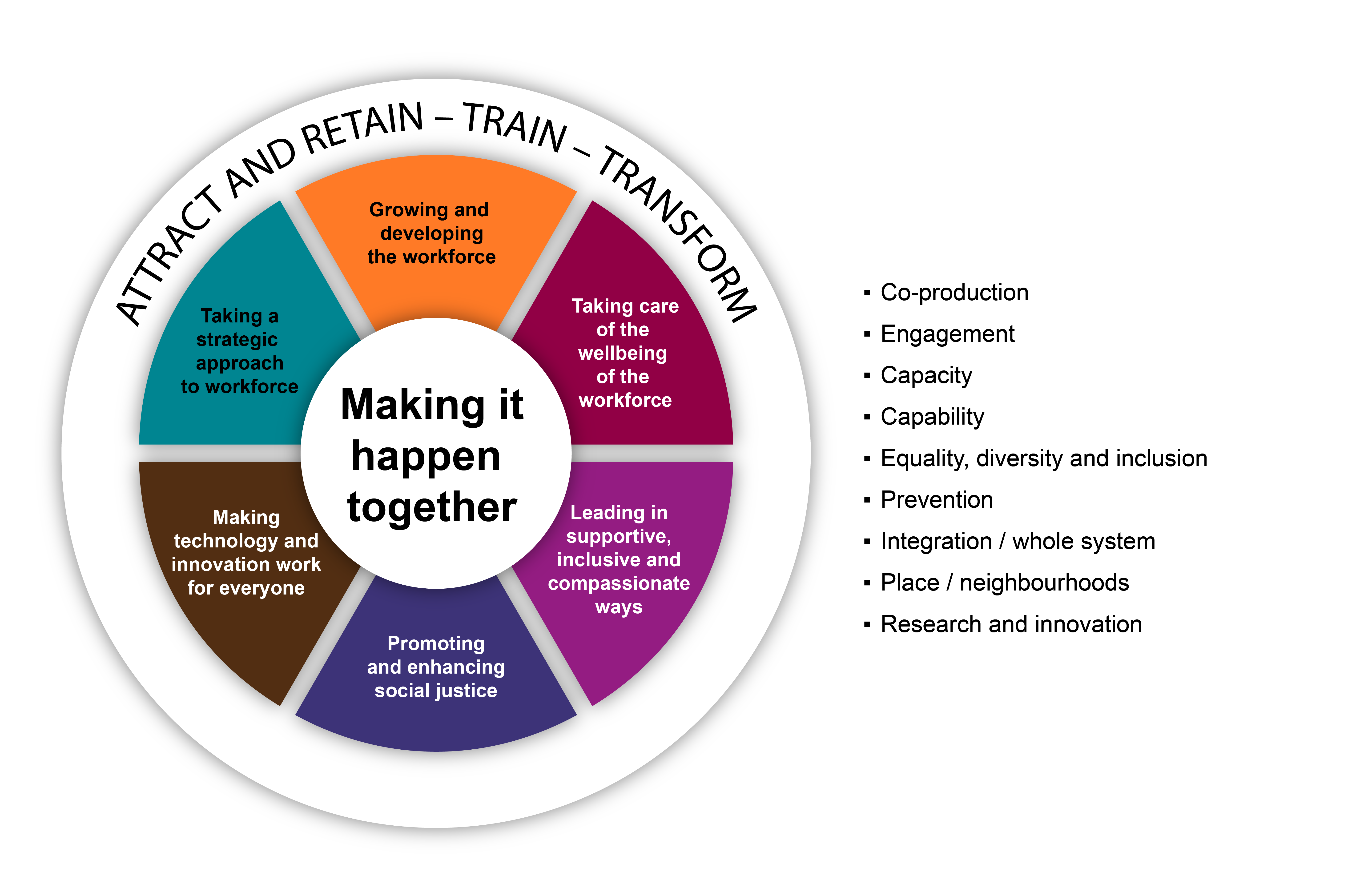
The I and We statements are grouped into six themes. Each theme has a number of ‘I’ statements that describe what good looks like from an individual perspective, and ‘We’ statements that describe what good looks like from a leader and organisation perspective to make sure we improve and support the workforce in ways that matter to people. Figure 2 sets out the six themes which include:
- growing and developing the workforce
- taking care of the wellbeing of the workforce
- leading in supportive, inclusive and compassionate ways at all levels
- promoting and enhancing social justice for the workforce and people they support
- making technology work for everyone
- taking a strategic approach to workforce.
The Workforce Together, I and We statements framework
Together statements
"Together’ statements" describe what good looks like when everyone works together to make sure we are putting the people who draw on care and support at the heart of co-producing the care and support.
- Together, we make sure that everyone is valued, respected and treated with dignity, humanity, and kindness.
- Together, we work to empower people to have more choice and control over their own lives and their care and support. We advocate for people who are unable to self-advocate.
- Together, we put the people who draw on care and support at the centre of what we do and work to make the things that matter to them happen.
- Together, we commit to building a future where everyone can live happy and fulfilled lives in strong and inclusive communities.
- Together, we are learning and developing ourselves so we can support people to live their best lives.
- Together, we take time to get to know the people who draw on support, and care about them, not just for them.
- Together, we are committed to addressing inequalities and safeguarding concerns.
- Together, we create safe spaces for co-production and reflective practice, and work to make life better for everyone.
- Together, we value, welcome and celebrate diversity and inclusion.
- Together, we look out for each other to make our experience of work the best it can be.
- Together, we commit to taking action towards preventative care and offering support earlier, so that more people can live the lives they want.
I and We statements
‘I’ statements' describe what good looks like when you work in and provide care and support.
‘We’ statements' describe what good looks like if you are a commissioner, leader or part of a team or organisation that commissions or delivers social care services.
Appendix 1: Behind the scenes - how the workforce statements were co-produced
The Workforce Statements evolved from a review of the ADASS, LGA and Skills for Care national Shared Workforce Priorities in 2023-24. Over 700 people across adult social care departments in councils, social care providers, health representatives and other partners were consulted as part of the review. The insights from the consultation framed the initial thinking around the Workforce Statements, and the co-production with people with lived experience of care from across England using the Curators of Change ‘Over a Brew’ methodology, has been central in developing the statements.
This included:
- people with lived experience with diverse backgrounds and experiences of care, including family carers,
- people working in different roles including those working directly in support roles, and people leading and managing social care teams (including practitioners, personal assistants, registered managers, commissioners, workforce leads and policy makers).
A series of online workshops were an important part of developing early versions of the Statements. As the conversations progressed, the stories from people’s lived experience – both people working in care and people drawing on care and support – developed and helped to give context to the Statements. The insights from all workshop sessions were captured and translated into the Together, I and We statements. The first statements were shared and tested with the National Community of Practice for Care and Health Career Academies and with the TLAP’s National Co-production Advisory Group (NCAG), a membership body made up of people who draw on care and support. A survey was shared to help sense check and prioritise the Statements to develop the final version.
Over the past two decades, there has been a growing emphasis within health and care on ensuring that the voices of people who draw on care and support are heard. This was strongly echoed in our conversations, alongside calls for more co-production with people who provide care and support.
We are immensely grateful to the diverse range of people who provided their insights and expertise during this project, both at the workshops and through informal discussions. Many have generously shared their time, their experiences, challenges, what matters most to them, and what would make the greatest difference for improving their experience drawing on care and/or in working in care. We hope that the tangible learning captured in the Statements can help us catalyse action towards improvement that prioritises fairness, equity and inclusivity, and makes our social care workforce feel valued and supported. If you would like to share any further input and comments, please get in touch with us.
Appendix 2: National policy and frameworks context
The Workforce Statements framework aligns to the key national policy documents and frameworks, including the ones set out below. It also aligns to the Partners in Care and Health’s wider work promoting and supporting personalised, community-based and strength-based approaches to care and support.
The Workforce Statements place a strong focus on outcomes, co-production, equality, diversity and inclusion, and high-quality care maximising people’s choices. Addressing health inequalities through a focus on preventative and integrated neighbourhood working, can help not only improve the quality of life for individuals but also help reduce demand on the health and care system.
This co-production work highlighted the need for a stronger focus on relationships with the people and communities we serve and who most need care and support. It reiterated the importance of seeing people and their relationships and connections as assets to be drawn on to improve health and wellbeing. Focus on all these areas will be vital to delivering the three shifts set out by the Government.
The Care Act 2014 is the most significant piece of legislation in our sector. It shifts the emphasis on local authorities from a duty to provide services to meeting eligible needs of the local community. The Care Act places emphasis on co-production and outcome-based interventions throughout all the roles and functions that contribute to the provision of care and support. It frames social care around a duty to promote individual wellbeing and requires adoption of a holistic, person-centred, and proactive approach, emphasising prevention, integration, and safeguarding.
The co-produced Think Local Act Personal’s Making it Real Framework describes what good care and support looks like from the perspective of people who draw on care and support and the organisations and local authorities that support them. The Workforce statements align to and build on Making it Real framework, and when they are adopted, they will help people who work in care to deliver the good care and support described in Making it Real.
The Workforce Strategy for Adult Social Care in England was developed by Skills for Care in collaboration with partners in the sector, including people who draw on care and support. The strategy aims to “ensure that we have enough of the right people with the right skills to provide the best possible care and support for the people who draw on it”. It sets out the vision and direction for the short and longer term under three core commitments. The Workforce Statements support the three commitments in the national strategy, by focusing on attracting and retaining, training, and transforming the workforce.
The National Shared Workforce Priorities for ASC were developed jointly by ADASS, LGA and Skills for Care with councils in each of the nine regions, partner organisations and people who draw on care and support. The shared priorities align to the three commitments in the workforce strategy. The Workforce Statements can support people in putting the six priorities into practice. The statements form an easy to use checklist of how organisations should support their workforce, and what people who work in care should expect from the organisations who employ them.
The Time to Act report by the Association of Directors of Adult Social Services (ADASS) outlines a roadmap for transforming adult social care in England. It identifies ten key areas for action to support the shift towards the system we want to see in the future, including addressing social care workforce challenges, supporting community capacity for wellbeing and prevention, and ensuring accessible care for all across England. The Workforce Statements can be used to support these key areas for change.
The Care Quality Commission (CQC) Assurance Framework is a structured approach to evaluating the quality of health and social care services in England. The assessment focuses around five key questions: safe, effective, caring, responsive, and well-led, to ensure focus on the things that matter to people. Under each question, there are quality statements that outline the expectations for care providers, commissioners, and system leaders to deliver high-quality, person-centred care. The Workforce Statements can be used to support thinking through the workforce issues in relation to the five key questions.
Neighbourhood health guidelines 2025/26 – Neighbourhood health aims to create healthier communities, helping people of all ages live healthy, active and independent lives for as long as possible while improving their experience of health and social care, and increasing their confidence and sense of control in managing their own care. The Workforce Statements can support workforce development to meet the care and support needs of people in local neighbourhoods.