This section will outline a model of ‘systems thinking’ which we are recommending is adapted for use as part of delivering support and embedding improvements in health and social care systems, and complements the findings presented in the following section.

We have learnt that a lot of good work is happening in systems but, repeatedly, we have seen a rush to action and improvement work tackled through a microsystem lens in a siloed way. This leads to the same problems being solved in multiple ways, multiple times in isolation within organisational services and teams. Knowledge is not shared, and learning can be left isolated, uncaptured and unconnected. It is not considered for replication or scaling up. This stops systems gaining maximum benefit and embedding lasting impact.
We know that health and social care are interdependent systems, where pressures and challenges in one organisation will spill into and impact others. Improvement of services requires an understanding and consideration of health and social care as one complex system. To better navigate and respond to such complexity, we are applying systems thinking as a framework for understanding and tackling interrelated system issues.
This section will outline a model of ‘systems thinking’ which we are recommending is adapted for use as part of delivering support and embedding improvements in health and social care systems, and complements the findings presented in the following section.
The problems that are ideal for a systems thinking approach tend to have the following characteristics, reflected in health and social care systems:
- the problem is important
- the problem is chronic, not a one-time event
- the problem is familiar and has a known history
- people have unsuccessfully tried to solve the problem before.
The concept of systems thinking originated in 1956 at the Massachusetts Institute of Technology (MIT). It provides an effective approach to improvement of services, as it considers how different complex entities interact and influence each other, making up the whole system.
Peter Senge, leading systems thinker and MIT professor, describes the traditional approach to improving organisations as focusing on ‘critical success factors’. A list of goals or areas of improvement are prioritised and pursued one by one. This can mean that the importance of the interaction between these factors is missed. Systems thinking, instead, focuses on:
- the organisation or system as a whole
- interactions between parts
- the way sub-systems affect other sub-systems, and the whole system
- recurring patterns, not just individual events
- change over time
- how feedback affects the parts.
Dr Daniel Kim, also previously of MIT, argues that the complex world we operate in demands greater focus on the interrelationships that lead to success. The more clearly organisations can understand, evidence and articulate what does or does not lead to success, the more deliberate they can be about investing in those features that do. Kim describes an organisation which seeks to consistently improve as a ‘learning organisation’. Kim’s model of a successful learning organisation is illustrated in Figure 2.
The core theory of success for learning organisations
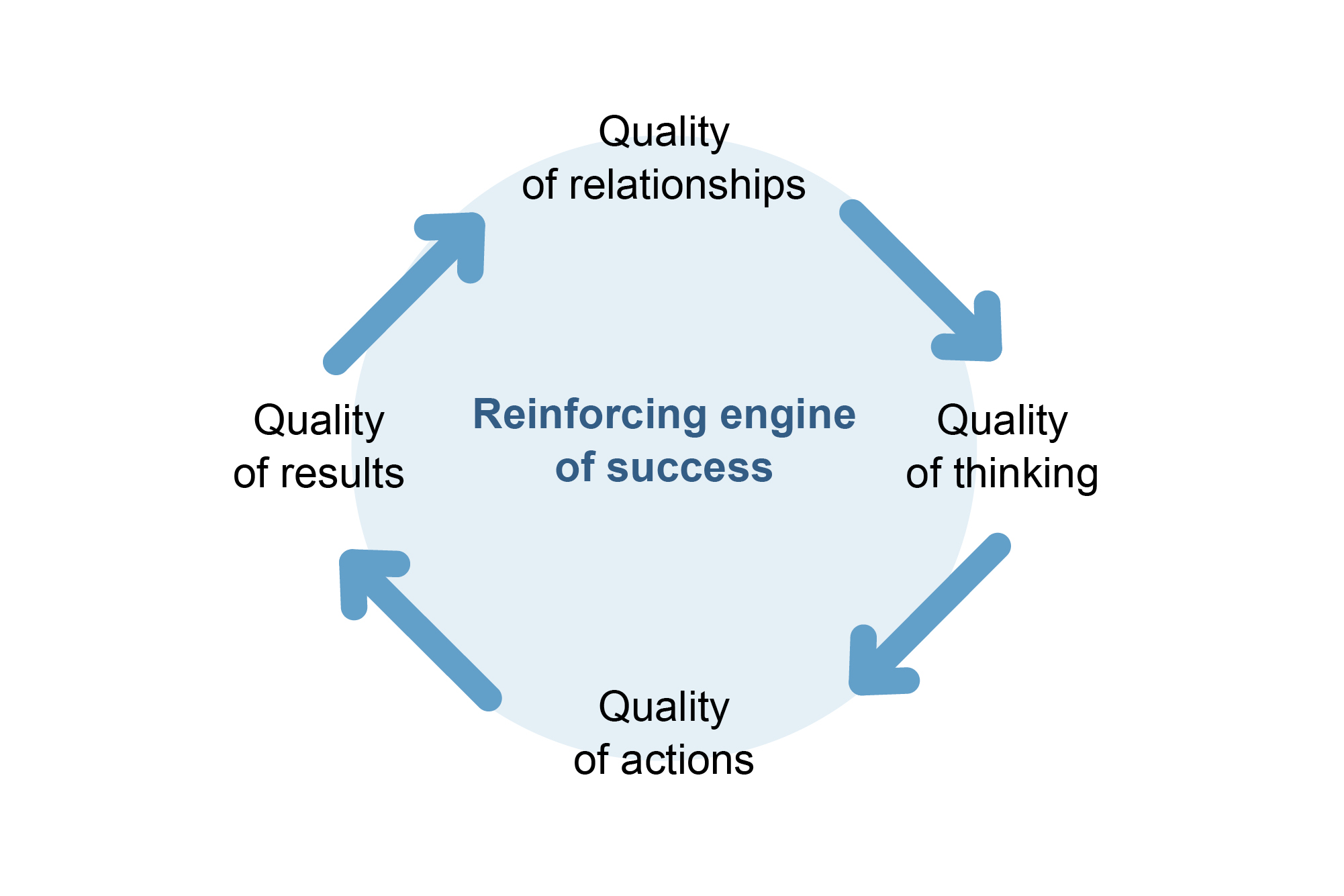
The diagram above shows how to reinforce the engine of success using the four gears of the engine: quality of relationships, quality of collective thinking, quality of action, and quality of results – provides systems and organisations with the mechanism to consistently improve because they form a positive, reinforcing loop.
"As the quality of relationships amongst people who work together rises (high team spirit, mutual respect and trust), the quality of thinking improves (people consider more facets of an issue and share a greater number of different perspectives), leading to an increase in the quality of actions and results (better planning, greater co-ordination and higher commitment). Achieving high-quality results has a positive effect on the quality of relationships, creating a reinforcing the engine of success."
- Daniel Kim, co-founder of the Massachusetts Institute of Technology (MIT) Centre for Organisational Learning Source: https: thesystemsthinker.com/what-is-your-organizations-core-theory-of-success
The four gears of the engine – quality of relationships, quality of collective thinking, quality of action, and quality of results – provides systems and organisations with the mechanism to consistently improve because they form a positive, reinforcing loop.
Our insights and learning have led us to conclude that this is both relevant and adaptable to local health and social care system, as well as the wider sector where the right conditions for success are essential in driving and embedding sustainable improvements.
Conditions for success for integrated health and care systems
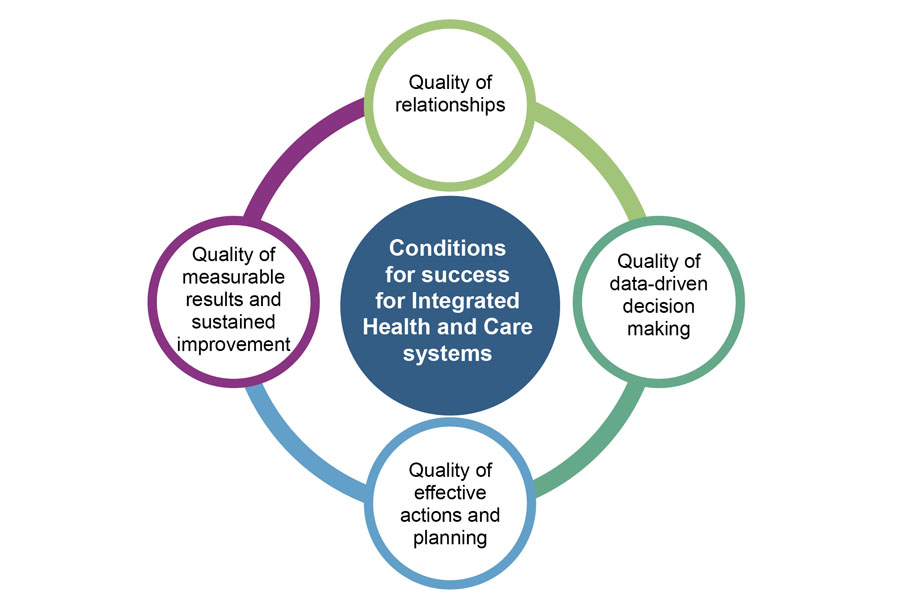
The diagram illustrates the conditions for success for Integrated health and care systems are: the quality of relationships; the quality of data-driven decision making; the quality of effective actions and planning; and the quality of measurable results and sustained improvement.
Impactful and sustainable improvement of health and social care services relies on understanding issues from a whole system perspective and addressing them with a whole system approach. The Kim model provides the framework for the conditions of success required for health and social care leadership partners to do so. We are recommending this model, which is used to frame the insights and learning from the Programme in Section 4
Alongside this framework, health and social care leaders need a clear operating method or Management Operating System (MOS), a key element of the improvement infrastructure.
An MOS refers to a set of collective ways of working – processes, tools, meetings and behaviours – which align strategic goals with activities. Critical elements of an MOS include:
- strategic planning: clear lines between the vision of an organisation and day to day tasks
- performance evaluation: agreed methods and metrics to track and manage progress towards shared vision
- data analysis and reporting: use of data to make informed decisions and improve processes.
A well-implemented MOS has many benefits, such as:
- better communication: ensuring all partners are aligned and informed
- enhanced efficiency: streamlined operations, reducing time and effort on tasks
- improved decision-making: access to real-time data allows for informed decisions
- increased accountability: clear allocation and tracking of actions enhance responsibility.
While an MOS can be transformative, we recognise the challenges with implementation such as:
- complexity: setting up an MOS can be resource intensive
- resistance to change: staff may hesitate to adapt to new systems.
The MOS plays a key role in enabling collective accountability and operational discipline, mitigating the tendency for partners to retreat into organisational siloes under pressure. Health and social care systems should be supported to implement shared and integrated MOSs.
Figure 4
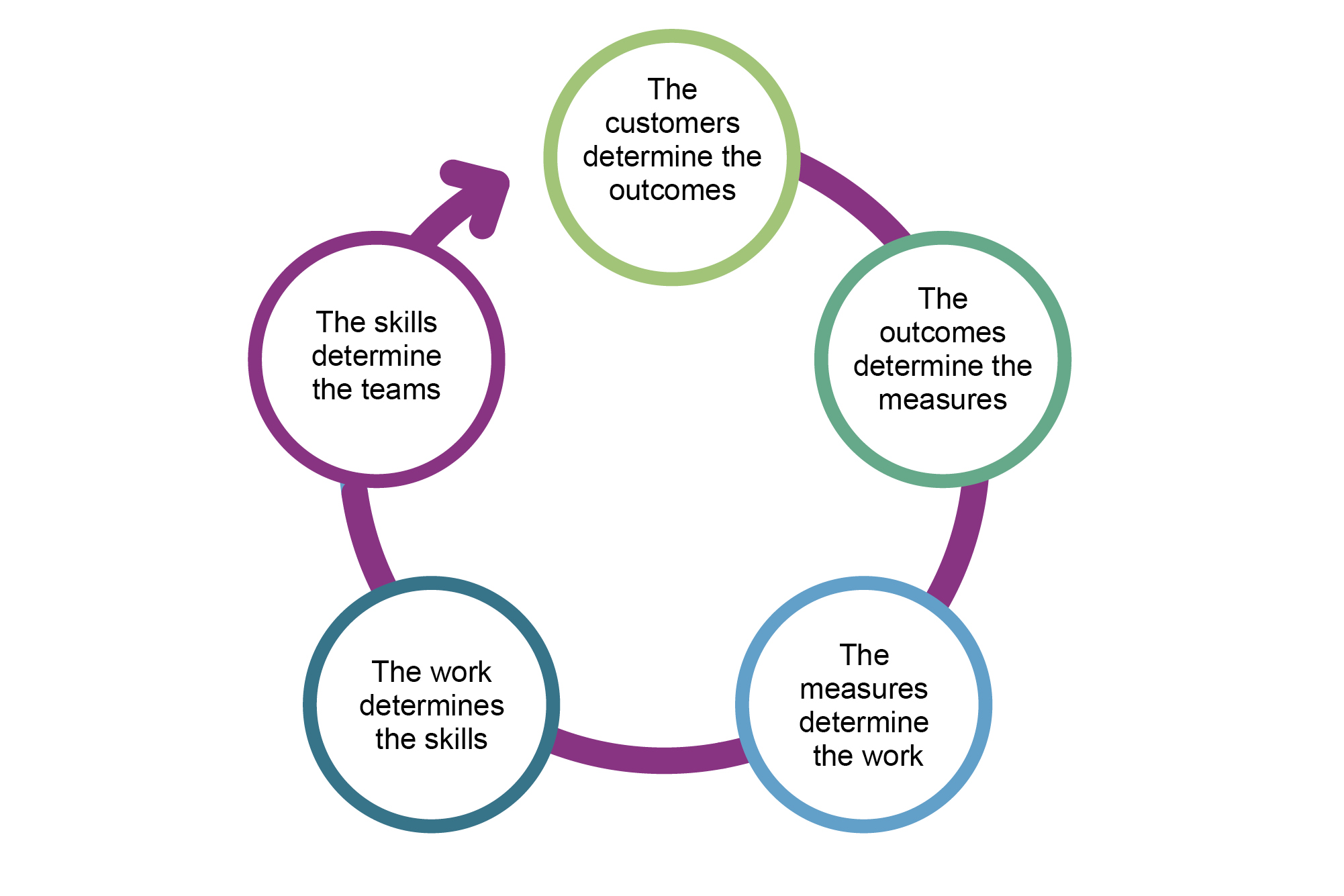
The diagram above shows the steps to success for health and social care systems: The customer determines the outcomes; the outcomes determine the measures; the measures determine the work; the work determines the skills; the skills determine the teams.
The Thoughtworks Simplified Operating Model starts with the customer. Organisations optimise their operating models to maximise the value they create for customers, rather than designing work based on what their teams cad do, and what they want to achieve for the business. Each element builds its own momentum and allow work to cascade through.
Source: Five dysfunctions of an operating model – and how to avoid them