Liverpool City Council’s Parenting Team coordinated the expansion of the programme, working with schools, Family Hubs, children’s centres, prisons, and community organisations. Through coproduction, outreach, and targeted training, staff across the city were supported to become parent group facilitators, by training to deliver the 10-week group-based Programme.
Overview
As Liverpool transitions to a Family Hub model, integrating early help and parenting support across schools, early years settings, and community services has been central. The city’s parenting offer spans from preconception to age 19 (or 25 for those with SEND), offering both universal and targeted support. A key goal has been to make parenting support accessible in the places parents already go, like schools, children’s centres, and community venues, while strengthening the skills and confidence of the workforce to intervene earlier and more effectively.
To meet these goals, The Nurturing Programme from The Centre for Emotional Health was selected as a core component of the parenting offer. Its focus on empathy, appropriate expectations, positive discipline, and parental self-awareness aligns with Liverpool’s ambition to promote strong, healthy parent–child relationships.
The Nurturing Programme is evidence-based, suitable for both universal and targeted delivery, and well-regarded by practitioners and parents. Importantly, it can be delivered in schools, prisons, and third sector organisations, enabling integration with the Family Hub model.
Why It Was Needed
Liverpool is the fourth most deprived local authority in England for children, with nearly 29% living in relative poverty. The city’s public health strategy highlights growing threats to children’s wellbeing, including mental health, obesity, and the long-term impact of poverty. We know that what happens in early childhood affects physical and emotional health into adulthood and that strong early relationships and parenting skills are protective, particularly in communities under pressure. In this context, equipping professionals across the system with the tools to support parents before crisis has been a priority. The Nurturing Programme has helped them to do this.
What Liverpool Did
Liverpool City Council’s Parenting Team coordinated the expansion of the programme, working with schools, Family Hubs, children’s centres, prisons, and community organisations. Through coproduction, outreach, and targeted training, staff across the city were supported to become parent group facilitators, by training to deliver the 10-week group-based Programme.
By the end of 2024, 64 practitioners had been trained. In 2024, 25 programmes were delivered across the city. Facilitators agreed to deliver at least two programmes per year and return evaluation data on the impact for parents. The central team provided resource packs, ongoing peer support, coordination, and advertising assistance.
The decision to embed delivery in schools and trusted community spaces was deliberate. These are places parents already know and feel comfortable in. As one facilitator noted:
“When parents attend sessions in their child’s school, with a staff member they know, they’re more likely to trust the process—and to complete the programme.”
What Parents Said
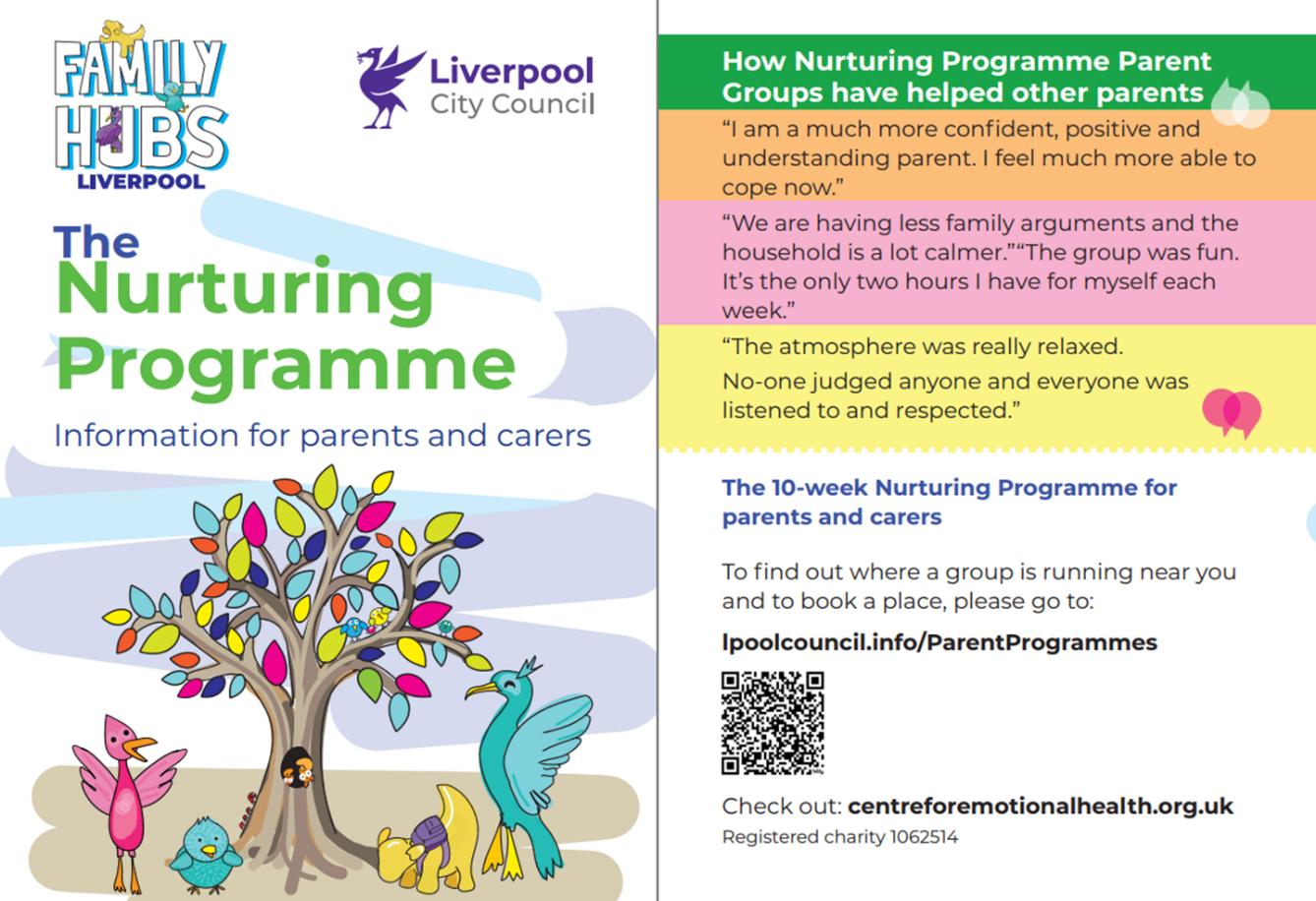
Feedback has been overwhelmingly positive. Parents have spoken about increased confidence, reduced stress, improved relationships, and changes in their children’s behaviour:
I really enjoyed the course. It taught me a lot of things I thought I knew—but maybe didn’t. Or gave me a different insight into parenting from other people’s points of view, lifestyle or religion. It was nice to share with other families. I think we all learned a bit from each other.”
I thought my son was always trying to wind me up and there wasn’t that much communication, but now I feel that I love him so much and I am enjoying being with him all the time.”
One father said: “I already thought I had a basic understanding of what was needed as a father, but I have
learned so much more. I’ve learned a lot about myself during this time, so I am very
grateful to have been part of it.”
Impact and Outcomes
In 2024, 136 parents reported their skills and confidence across a range of domains using the TOPSE (Tool to Measure Parenting Self-Efficacy).
On average, parents reported a significant improvement in their total score (+51 points, from 347 to 398 out of a possible 480). The improvement was even higher for the 40% of parents with the lowest starting scores (+88 points, from 293 to 381).
The domains that parents reported the biggest improvements were:
• Discipline and boundaries (+9.4 points, from 39.2 to 48.6 out of 60)
• Managing pressures (+5.9 points, from 34.9 to 40.8 out of 60)
• Empathy and understanding (+6.2 points, from 46.3 to 52.5 out of 60)
• Sense of control in parenting (+8.4 points, from 36.0 to 44.4 out of 60)
These outcomes suggest that The Nurturing Programme was able to improve confidence in parenting skills and strengthen family relationships in a meaningful way.
Facilitators also noted that their relationships with parents often improved through the programme, meaning that parents felt more able to access additional offers of support.
Challenges and How Liverpool Addressed Them
Some organisations initially struggled to deliver group programmes. This was addressed through follow-up with staff from those organisations, peer mentoring, and direct support from experienced facilitators.
Challenges also arose around accessibility for parents who do not speak English. Some translated materials were available, but gaps remain, especially for Arabic-speaking parents.
One successful solution has been training community-based facilitators, such as a volunteer leading a Muslim women’s group, who now runs programmes in a language and context that parents relate to.
We are exploring further use of this community-led model. Parents have also been encouraged to bring an English-speaking person to group sessions. Data collection initially lagged but has improved significantly through ongoing support and regular contact with facilitators in different organisations. Evaluation is now seen as a core part of delivery, not an optional extra.
Sustaining and Scaling the Model
There are now an average of 24 Nurturing Programmes running each term across the city. Group sizes range from 6 to 12 parents. Facilitators are supported by the Parenting Team, including three full-time Parent Inclusion Leads who provide mentoring and delivery support.
The model is embedded into Liverpool’s Family Hub offer and has gained momentum across settings. Liverpool is now working with other local authorities through The Centre for Emotional Health’s Learning Partnership collaboration to share best practices and compare our impact data with other
local authorities.
Liverpool showcased their work at the Children and Young People Now conference in March 2025, have been featured on the Local Government Association as a case study, and were invited to present to the All-Party Parliamentary Group on Family Hubs.