This case study outlines how Westminster City Council is moving towards a more holistic view of performance, including value for money and risk.
Background and introduction
Westminster City Council governs a central London borough covering 8.29 square miles, home to significant areas such as the West End, Parliament and the Royal Parks. It has a resident population of just over 205,000, which can swell to more than one million people daily due to commuters and visitors. Westminster has a young profile with 75 per cent of its population of working age, alongside high population density and marked contrasts in wealth and deprivation across neighbourhoods.
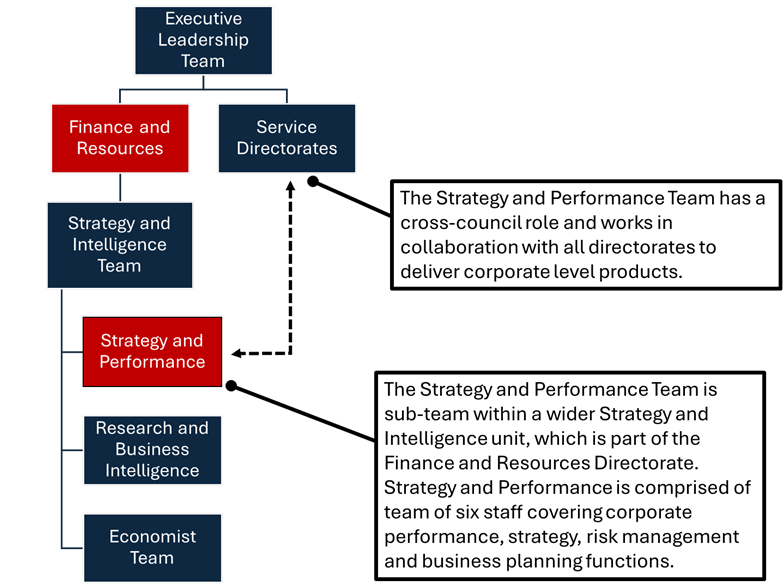
The council operates a ‘hub and spoke’ approach to performance management. The Corporate Strategy and Performance team is the council’s strategic performance management function. The team analyses and reports on performance data and information from across the council, providing assurance and accountability for senior leaders and staff that its core services are delivering for residents. This complements performance teams in the council’s directorates who focus on specific service performance.
A new vision for strategic performance management
How does a corporate performance team genuinely add value to what councils do? And particularly at a time of relentless financial and service pressures and the inevitable need to justify the value of corporate functions? And how can technological changes be harnessed to make performance reporting faster, simpler and more meaningful? These questions prompted the strategic performance team to ‘step back’ and consider its purpose and vision, resulting in a new performance management strategy (available on request).
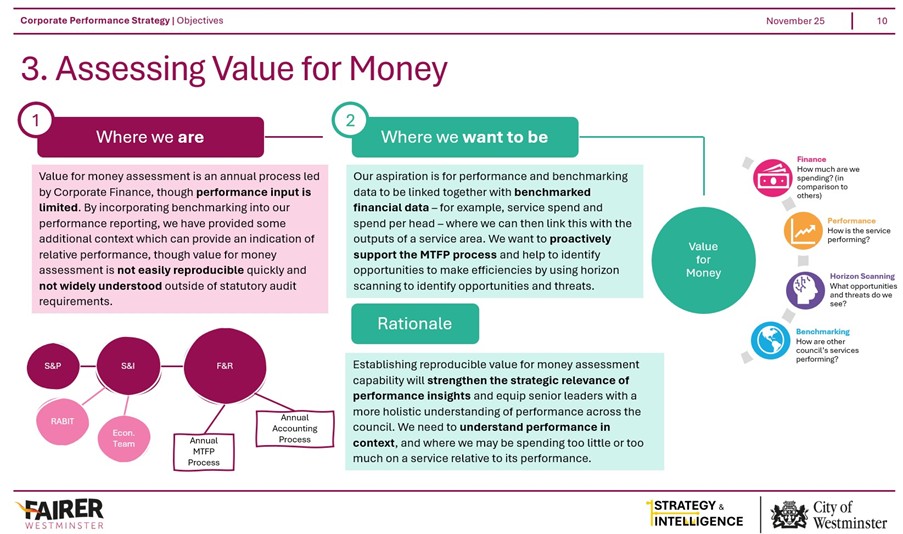
The team, with input from the organisational leadership, devised a new vision and key principles for the strategic performance management function. It is closely linked to a refreshed people and workforce strategy, known as the Westminster Way, which provides a stronger connection between individual and service objectives and the council’s strategic objectives. Analysing value for money (vfm) by evaluating service performance within the context of service spend is one of five key principles of the council’s new strategic approach.
Westminster Corporate Performance Strategy: Overview
Vision
Our vison is for a more effective and efficient corporate performance function. We will add value to the council by giving senior leaders high quality, multi-dimensional performance insights integrated with broader financial, benchmarking, project and programme information.
Objectives
We will achieve our vision by delivering our objectives, including automating our performance reporting, multi-dimensional performance, assessing value for money, benchmarking, and improving the quality and transparency of our data.
Principles
We will follow the principles of being transparent, strategic, agile, insightful and value for money focused to achieve our objectives and vision of a more effective and efficient corporate performance function.
Westminster Corporate Performance Strategy: Principles
Our strategy will be grounded in five key principles that will provide focus to the direction we take to achieve and shape how we will work to achieve our objectives.
1. Transparent
We will be transparent, sharing and promoting performance insights with key stakeholders, council staff, and where possible, residents, and we will promote this culture of transparent performance management across the council, with the goal of creating a mature and holistic understanding of performance assessment.
2. Strategic
We will be strategic, seeking to align corporate performance horizontally and vertically across all domains, including project and programme information, directorate level performance information, committee reports, and broader intelligence.
3. Agile
We will be agile, working to manage competing demands, priorities, and requests, and showing flexibility by adapting our performance function to shifts in the wider strategic landscape.
4. Insightful
We will be insightful, connecting performance insights with wider quantitative and qualitative intelligence, and adding value by providing big picture analysis.
5. Value for money
We will be focused on ensuring value for money for residents by analysing and evaluating service performance within the context of service spend.
Current arrangements
At present, the council has a ‘basket’ of corporate key performance indicators (KPIs) which are reviewed and agreed each year, with data supplied by directorates. They fall into three categories of KPIs: service (including service satisfaction), management and outcome. They are selected for corporate reporting by relevance to strategic priorities. Directorates provide targets for these KPIs and they are ranked red, amber, green according to whether they hit their performance target.
Operational performance reporting is quarterly through a publicly accessible Audit and Performance board report. Strategic reporting happens via an internal risk and performance board report for consideration by the Executive Leadership Team. The report for these sessions contains embedded performance dashboards covering performance, risk and strategic delivery. All benchmarking data for metrics is provided via LG Inform Plus using an API (application programming interface) with automatic updates.
Moving towards a holistic view of performance, including value for money
To provide better strategic insights and assess performance more accurately with regards to causes and drivers, the council is moving to a more nuanced approach, where a smaller set of KPIs is assessed against four elements:
- How much are we spending in comparison to others?
- How is the service performing in the context of the council’s priorities and ambitions?
- How does the performance compare to others?
- What opportunities or threats are on the horizon that need to be considered?
Assessing value for money
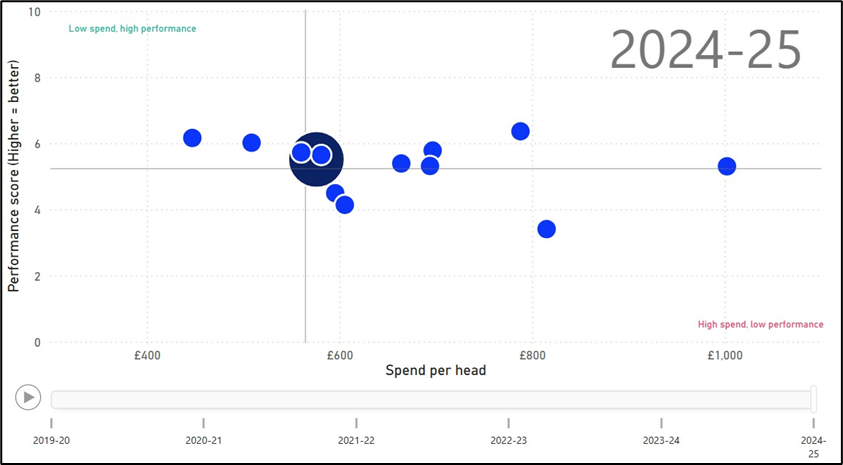
The team have developed a range of vfm reports, drawing on data from LG Inform and benchmarking against London councils and councils nationally. These can show not only performance and spend over time but also relative value for money. The council’s approach has been to link service expenditure data with baskets of relevant service metrics to create a relative performance score for statutory service areas, as shown in the chart below.
The model uses nationally available council level data via LG Inform Plus and allows year on year analysis of relative vfm using spend per head or other suitable denominators.
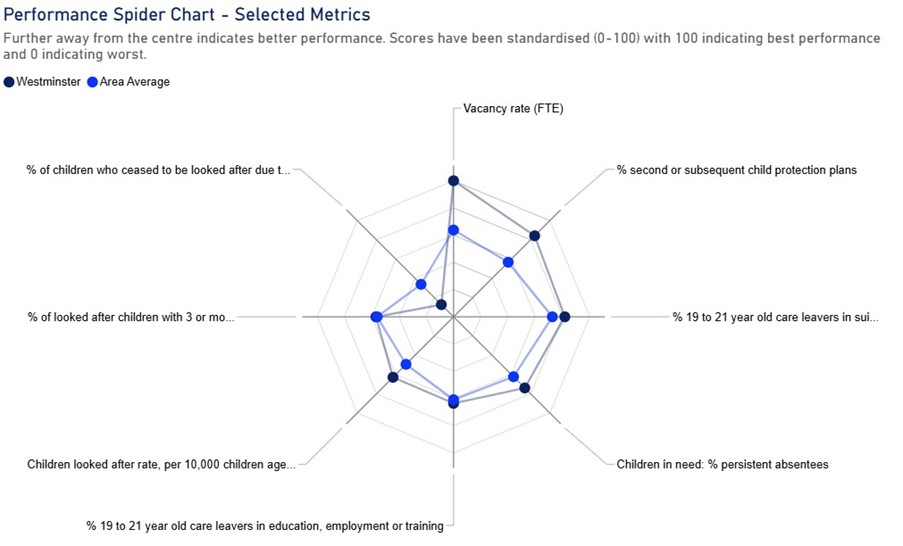
The team is also experimenting with ways of visualising performance information in a more holistic way to show interdependencies between different KPIs.
In addition to these reports, the team has established an ‘external insights library’ that uses AI to collate and store national policy, strategy or services issues and opportunities automatically, with minimal human effort. The searchable tool can filter content to be considered as part of performance conversations or to provide content or insight for reports.
The team has been working to make these reports and tools widely available across the council, where additional value can be felt. The council has a dedicated intranet page for council strategy, performance, risk management and insights. Reports, dashboards and tools can be readily accessed by staff, which has helped channel-shift basic data and strategy enquiries to self-service.
Impact
In line with the council’s vision, changes to reporting aim to enable managers to have more insightful conversations that consider and challenge performance in the context of financial spend and external influences. The new approach also seeks to highlight areas where performance deep dives are required.
Reporting to the council’s Executive Leadership Team has been strengthened considerably, moving from formal written reports with extensive data tables to an interactive report with embedded dashboards that are used as standard by executives.
Reporting by exception, the focus is now on providing corporate supporting narrative in the form of value-add insights as part of performance review. The council now has benchmarking, relative cost or value for money of services, risk and opportunity context as part of the performance narrative.
The major outcome has been the way this approach has enabled active discussions around performance review and what should be in the council’s performance framework as priorities change - leading to improvement actions and prioritisation-based decision-making at the highest level.
Tips
- Get buy-in from others, most importantly senior managers and leaders. If you haven’t, persevere until you get it.
- Having technical skills in your team will be a game changer. Recruit someone with the skills as well as the imagination to make the changes to reporting and visualisation.
- Don’t take things too far before you have tested them with others.
- Think about the cultural changes you need for value for money reporting to stand the test of time.
Key documents
Contact
Nick Byrom: [email protected]
Strategic Performance Manager, Strategy and Performance Team
William Jones: [email protected]
Performance Analytics Lead, Strategy and Performance Team