Are you confident your council’s decisions consider the opportunities to improve your communities’ health and wellbeing? Our health, and the gap between good and poor health in our communities, is shaped far more by where we live, learn, work and play than by hospitals.

These wider determinants or ‘building blocks’ of health include warm homes, safe streets, good jobs, clean air, education, transport, green spaces and social support. Councils have significant influence over many of these wider determinants of health.
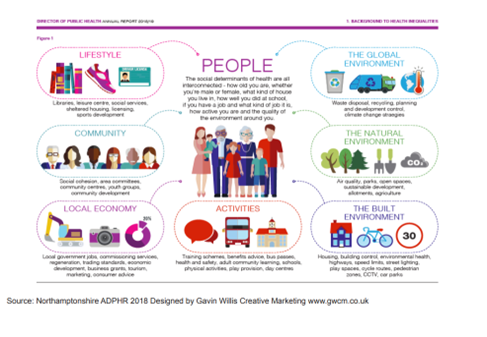
By embedding considerations of health and health equity in decisions about the wider determinants, there is potential to:
- Reduce pressure on your local social care, NHS and other public services by tackling problems before they start.
- Deliver shared wins: from better-connected transport and inclusive growth to warmer homes and safer streets.
- Tackle inequality: target resources where needs are greatest, to level the playing field and narrow the health gap.
Health in All Policies (HiAP) is “an approach to public policies that systematically takes into account the health implications of decisions, seeks synergies, and avoids harmful health impacts.” (World Health Organisation Helsinki Statement, 2013.
Leicestershire: embedding health in every decision
Leicestershire County Council introduced health impact questions into its decision-making process and supported staff with training and tools. The result? More than 250 people have already applied this thinking to areas like libraries, school buildings, and transport planning. The approach helps deliver better decisions, saves money through prevention, and ensures that health is considered early, when it can make the biggest difference
HiAP asks us to ‘think health’ before we decide. It’s a smarter way of working:
- It can be applied at any scale, from frontline service decisions to corporate plans, Local Plans and homelessness strategies, to cross-authority economic deals.
- People, communities and partners come together, to understand how decisions may impact on health, to identify and shape solutions to improve health, to share resources.
- It’s about prevention: a small change ‘upstream’ eg, in a planning decision or licensing policy, can delay or avoid costly downstream health and social care needs.
Southampton: tackling substance harm with a whole-council strategy
Southampton City Council used a ‘health in all policies’ approach to create a single strategy for tobacco, alcohol and drugs that spans all council departments. Each directorate leads on its own part, making it easier for staff to take ownership and act. This whole-council approach has built relationships, improved services, and laid the foundation for long-term progress on complex health issues.
What you can do next
- Find out if your council is already considering health and wellbeing in decision-making and taking a health in all policies approach across the council: speak to your local public health team, have a look at Council, Scrutiny and other committee reports for a ‘health implications or consideration’ section, and ask officers if and how they’re doing this.
- Review upcoming decisions in the Forward Plan: think about how these have the potential to impact on your communities’ health and wellbeing, and inequalities, and where there might be opportunities to achieve ‘win wins’ such as an improved health and more people in good employment
- Ask for consideration to health, wellbeing and equity in some or all of the decisions you feel have the potential to impact, for example request health impact assessments where decisions have potential to impact on specific neighbourhoods or populations who already experience inequalities
- With officers, and partners, share the stories you hear from your communities about how their lives, health and wellbeing, are affected by the wider determinants of health; facilitate and advocate for your communities to be involved in decisions that have the potential to affect their health and wellbeing
- Refer to the LGA’s guide to local authority public health responsibilities and ideas and stories of how other councils are taking this approach on the case study sections of our Public health improvement programme and Health and wellbeing board maturity matrix pages respectively.
East Sussex: working together on health and housing
East Sussex created a cross-sector partnership with a shared vision: safe, healthy homes for all. The strategy brings together councils, health services and communities to tackle homelessness, poor housing, and fuel poverty. It shows how long-term partnerships can improve services and reduce pressure on health and care by addressing problems at their root.
Questions you could ask about Health in All Policies (HiAP)
Rationale and back to the main Public Health Improvement programme page