
Introduction
The Care Act 2014 sets out how councils should identify and work with young carers, and adult carers of disabled children (parent-carers), to plan an effective transition to the adult care and support system using a ‘whole family’ approach.
This edition updates the original ‘The Care Act and Whole-Family Approaches’ published in 2015. Ten years on, it’s in need of some updating although much of the content remains relevant and is included. Where practical, we have signposted to the most recent resources available to support embedding a whole family approach rather than reproducing them in detail here. It’s important to note that the Care Quality Commission (CQC) explicitly reference ‘The Care Act and Whole-Family Approaches’ in their good practice guidance section as part of their Assessment Framework so this updated version is timely.
In 2023, Partners in Care and Health (PCH) commissioned Carers Trust to update and refresh the ‘No Wrong Doors for Young Carers’ template memorandum of understanding (MOU). The MOU aims to embed a whole system approach to identifying and supporting young carers, young adult carers and their families, and improve joint working between adult and children's social care services and integrated care boards. One of the commitments made by signatories to the MOU is to “work together, adopting a whole system, whole family approach to ensure we are identifying and providing support for all young carers, young adult carers and their families.” This version of ‘The Care Act and Whole-Family Approaches’ is designed to complement the MOU, which can be found on the Carers Trust dedicated webpage, alongside additional resources including implementation guidance, a briefing note, and helpful checklists.
As part of their desk research in support of the refreshed MOU, Carers Trust found that while many councils listed relevant legislation, strategies and policy frameworks within their published Carers’ Strategies, none included the MOU or ‘The Care Act and Whole Family Approaches.’ We hope that this updated version will act as a prompt for councils to revisit the value of whole family approaches in ensuring better outcomes for carers and better outcomes for families.
Carers Trust have published a good practice guide: A whole family approach to supporting
Carers and you can find other resources in support of whole family and whole system approaches in our recently published briefing on Embedding ‘No Wrong Doors for young carers’ - working together to support young carers and their families: Leeds City Council and ‘No Wrong Doors for young carers’: maturity assessment. Our customisable slide deck [placeholder for weblink] on ‘The Care Act, Young Carers and Parent-Carers’ summarises the relevant legislative and policy landscape.
This update acknowledges the content developed by the original authors and their support with this revised version.
Nothing in this resource seeks to amend or replace statutory or other forms of guidance. Whilst every attempt has been made to ensure accuracy and promote best practice, this does not represent a formal statement of the law or government policy. Statutory Directors of Social Services and responsible officers should obtain further information or legal advice, as necessary.
About this resource
The Care Act 2014 tasks councils with adopting a whole system, whole council, whole-family approach, coordinating services and support around the person and their family and considering the impact of the care needs of an adult on their family, including children. This resource aims to provide practical guidance for practitioners working in adult social care in relation to carrying out assessments and developing plans which consider the needs of the whole family. It does not cover all aspects of the Care Act 2014, but is intended to assist practitioners to consider how to develop whole-family approaches as set out in Care Act statutory guidance (6.71-6.74). It also considers how the Care Act works in tandem with the provisions of The Children and Families Act 2014 to create a cohesive legislative framework that allows assessment and support for families to be combined where appropriate.
The legislative and policy landscape
Under the Care Act, councils must identify any children who are involved in providing care to an adult, including when they are assessing the needs of an adult or their carer. Where a young carer in a family is identified, the council must a) offer a needs assessment to the adult requiring care and support and b) consider whether the child or young carer should be referred for a young carer’s assessment or a needs assessment under the Children Act 1989, or a young carer’s assessment under s63 of the Care Act. Councils also have universal duties to promote the wellbeing of all carers in their area, and provide them with advice and information. In addition to identifying any children or young people involved in providing care to an adult, and establishing whether they are a ‘child in need’ under the Children Act, councils are required to assess young carers using a whole-family approach and ensure children and young people are not providing ‘inappropriate or excessive’ care. There is also a duty to provide a transition assessment for young carers as well as parent-carers if they (carer) are ‘likely to have needs for support’ after the child the look after after turns 18. Our customisable slide deck [placeholder for weblink] on the Care Act, young carers and parent-carers covers the relevant legislative and policy frameworks in more detail.
Since publication of the original ‘The Care Act and Whole-Family Approaches’ in 2015, there are some additional requirements placed on councils. Working Together to Safeguard Children 2023 –statutory guidance reinforces the message that adult services must establish whether there are children in the family providing care for an adult and whether the young carers need support and
The Health and Care Act 2022 places new duties on theNHS and Integrated Care Boards (ICBs) to consult “carers and representatives” about the planning and provision of services for themselves and those they support.
Details of the law relating to young carers, including how it is updated by these new requirements, are covered in detail in the implementation guidance (pages 39-47) for ‘No Wrong Doors for Young Carers’. Carers Trust have also published a Guide for Young Carers designed to support young carers and young adult carers to understand their rights.
The Health and Care Act 2022 also introduced a new duty on the CQC to assess councils’ delivery of their adult social care duties under Part 1 of the Care Act 2014. This came into effect on 1 April 2023. The aim is to provide assurance to local people about how well their council is discharging its statutory duties under the Care Act 2014.
CQCs Single assessment framework is structured around four themes:
- how local authorities work with people
- how local authorities provide support
- how local authorities ensure safety within the local system
- leadership
We know from published assessment reports that CQC do ask staff in councils about their duties towards young carers and parent-carers under the Care Act and they explicitly reference ‘The Care Act and Whole Family Approaches’ and ‘No Wrong Doors for Young Carers MOU’ in the good practice guidance section of their assessment framework so a working familiarity with these will be essential as part of preparation for CQC assessment. A council which has signed the ‘No Wrong Doors for Young Carers’ MOU will, for example, have evidence to offer that they are committed to whole system support for young carers, parent-carers, and their families.
You can find a toolkit on preparing for CQC assessment as it relates to unpaid carers on the LGA website, along with a handy summary of the Care Act as it relates to unpaid carers.
How to use this resource
The focus of this resource is on four key steps required to make whole-family approaches a reality:
Step one
Think family
Step two
Get the whole picture
Step 3
Make a plan that works for everyone
Step four
Check it's working for the whole family
Each of these steps is followed by key practice points that councils should take into consideration in implementing whole-family approaches. There are also some practical tools to aid implementation of whole-family approaches to assessment and care planning, which can be adapted and developed for local use. You can find these in the Appendix.
1. Think family: early intervention and prevention
The Care Act 2014 reformed the way that care and support for adults with care needs are met. It requires councils to adopt a whole system, whole council, whole-family approach, coordinating services and support around the person and their family and considering the impact of the care needs of an adult on their family, including children.
The provisions for young carers included in the Care Act 2014 are intended to link with those in the Children and Families Act 2014. The intention is to provide a clear framework for councils in taking a whole-family approach to assessing and supporting adults and young carers and delivering support in a co-ordinated way. Whole-family working is not a new concept and there is already a considerable focus on whole-family approaches in councils such as Leeds. The duty placed on councils to consider the impact of caring on family members and their support network makes it essential to learn from these approaches and develop them further within adult social care.
The wellbeing principle
The Care Act places “wellbeing at the heart of care and support”. Councils are directed to apply this wellbeing principle to adult carers, young carers, and parent-carers who fall within scope of the Care Act and whenever a council is carrying out its statutory care and support functions, or making a decision, about a person’s needs. Care Act statutory guidance (16.3) states that when undertaking transition assessments, the wellbeing principle as defined by the Care Act, applies to children, their carers and to young carers and “the wellbeing of each young person or carer must be taken into account so that assessment and planning is based around the individual needs, wishes, and outcomes which matter to that person.” You can read more about the health and wellbeing needs of young people in a series of case studies published by the LGA.
Although ‘wellbeing’ is not defined by the Care Act, councils are directed to consider these domains of a person’s wellbeing as set out in the regulations and chapters 1.5 and 1.6 of the statutory guidance:
- personal dignity (including treatment of the individual with respect);
- physical and mental health and emotional well-being;
- protection from abuse and neglect;
- control by the individual over day-to-day life (including over care and support, or support, provided to the individual and the way in which it is provided);
- participation in work, education, training or recreation; social and economic well-being;
- domestic, family and personal relationships;
- suitability of living accommodation
- the individual's contribution to society.
A vital aspect in considering an individual’s wellbeing is the context in which they live, their domestic and family relationships and the importance of achieving a balance between their wellbeing and that of any family or friends who are involved in caring for them.
Considering the person’s needs within the context in which they live helps recognise what’s important to them as part of a family unit, as well as individually, and builds on the collective strengths of the family and their support network. The knowledge and expertise of carers is a crucial part of assessment and support planning. It is also crucial that family roles and responsibilities, including parenting, are recognised, the impact on children is considered, and any caring roles undertaken by children are identified.
A whole-family approach to promoting wellbeing and preventing the need for care and support might include helping families to plan ahead for potential changes, such as an anticipated increase in care and support requirements or changes in family circumstances that will affect support levels. This could be done through the provision of targeted information and advice or through peer support networks. Supporting carers to prevent, reduce or delay their need for support might include a wide range of activity from helping them to look at how to get the right balance so that they have a life alongside caring, through to pre-bereavement support or support with re-establishing a life after caring including work, recreation and community engagement options.For families where there are children and young people, it could include support to help build adults’ parenting skills. Support for carers can also be aligned to work with the support available through carers’ support organisations, or for young carers, alongside young carers and other community-based support services.
What do we mean by ‘family’?
The Care and Support (Assessment) Regulations 2014 require councils to consider the impact on carers and anyone else they think relevant when looking at the needs of the whole family.
The government’s Family Test introduced an explicit family perspective on the public policy making process saying “ Healthy and strong family relationships are also recognised as an important component of individual, community and national wellbeing.” The Family Test includes a helpful list of some of the relationships at the heart of family life. This is not exhaustive but serves as a useful reminder of the variety of relationships that constitute family:
- couple relationships (including same-sex couples), married partners, civil partnerships, co-habitees and those living apart together (two partners who regard themselves as a couple but are not co-habiting)
- relationships in separated families, including between children and any parent they may no longer reside with, as well as relationships with extended family, especially grandparents
- parent and step-parent to child relationships
- relationships with foster children and adopted children
- sibling relationships
- children’s relationship with their grandparents
- kinship carers – relatives or friends looking after children who cannot live with their parents
- extended families, particularly where they are playing a role in raising children or caring for older or disabled family members
What do we mean by ‘carer’?
The Care Act relates to adult carers – people over 18 who are caring for another adult. It also tasks councils with ensuring that young carers' needs are not overlooked when adults are being assessed for support. The act sets out how councils should work with young carers, and adult carers of disabled children (parent-carers), to plan an effective and timely move (or transition) to the adult care and support system using a whole family approach.
A commonly used definition (DHSC, 2016) is that a carer is “anyone who cares for a friend or family member due to illness, disability, a mental health problem or an addiction.” The care provided is unpaid, and guidance is clear this support can be emotional as well as practical. A young carer is “a person under 18 who provides or intends to provide care for another person (of any age)” and a parent-carer (the Care Act term is a ‘child’s carer’) is defined as “a person aged 18 or over who provides or intends to provide care for a disabled child for whom the person has parental responsibility.” ‘Young adult carers’ are not defined in legislation but are usually regarded as aged 18-24.
We also know from the 2021 census that children as young as five are providing care and staff need to feel equipped for this; “Young Carers in Bunnyland” supplies free e-books and resources for work with primary school-aged children who may be carers. Carers Trust also has resources for working with younger carers.
The interdependencies and interconnections between family members mean that what happens to one affects everyone else. Caring is a universal activity and an important part of family relationships. Much caring activity in families is regarded an integral part of the day-to-day life and for some people, they do not require or desire additional support to continue with that activity outside of their own support networks. Circumstances can however arise which might impact on the ability to continue, in the short or longer term, to provide such support. The extent of the care and support may become excessive or, particularly in the case of children and young people, inappropriate. You can read more about the impacts of caring on young people’s life chances in a report from the All Party Parliamentary Group (APPG) Inquiry into the life opportunities of young carer and young adult carers.
What are inappropriate or excessive levels of care in the context of children or young people providing care for an adult?
Assessors in adult social care must establish if a child is caring for an adult, the possible impacts of this, ways to reduce their role in caring for an adult and refer for a young carers assessment under the Children Act.
Care Act guidance (2.50) says “Children should not undertake inappropriate or excessive caring roles that may have an impact on their development. A young carer becomes vulnerable when their caring role risks impacting upon their emotional or physical wellbeing and their prospects in education and life. A local authority may become aware that a child is carrying out a caring role through an assessment or informed through family members or a school [and] …should consider how supporting the adult with needs for care and support can prevent the young carer from undertaking excessive or inappropriate care and support responsibilities. Where a young carer is identified, the local authority must undertake a young carer’s assessment under part 3 of the Children Act 1989.”
Some of the tasks which may be considered inappropriate or excessive caring include:
- intimate personal care
- strenuous physical activity such as lifting
- administering medication
- financial responsibility
- emotional support to the adult.
Roles and identities in families are not singular or set and can fluctuate and evolve. For example, the role of carer is only one aspect of a person’s family relationships. An individual may be partner and carer, person in need of support and carer, daughter or son and carer, parent and carer or sibling and carer. As a child or young person, the duality of being a carer and a child is particularly challenging.
Many older couples find that each has their own needs for care and support but they also provide care and support to the other. This mutual caring can often be found with older families of someone with a learning disability, where the balance of the caring relationship between the long-term family carer (often a parent) and the person with a learning disability (normally an adult son or daughter) has changed. Often, without each other's support, neither person would be able to remain living independently within their local community. People who provide care for both an older person and a child (sometimes referred to as ‘sandwich carers’) find they have conflicting demands on their time and many different roles to fulfil. Not all carers live in the same household and some will provide care and support from a distance.
A whole-family approach is about more than simply considering the caring roles within a family. For example, in a family where a father has developed multiple sclerosis, the responsibility of practical and emotional support may fall upon his wife. However, his son may not know how to cope with the fact that his father is ill and his mother has much less time for him than previously. While the son would not be defined as a young carer, his father’s needs for care and support have nevertheless had a major impact on him and he may require other forms of support.
Recognising the complexity of these relationships is important in order to respond to supporting these multiple and co-existing family roles. Many people value their role in providing care and support to an individual but there is ample evidence of the negative impact caring can have on their health and wellbeing if their needs are not addressed and support provided at an early stage. Taking a whole-family approach from the outset means councils stand the best chance of identifying everyone’s needs, including those with caring responsibilities, and supporting people to achieve the outcomes that are important to them whilst maintaining a strong supportive family unit.
‘Think family’ means coordinating services and support so that they work around the family. This will involve breaking down professional barriers and achieving changes in culture to enable practitioners work across organisations and service providers to achieve the best outcomes for the whole family. This will help support and maintain strong families and contribute to actively promoting wellbeing and independence, preventing or delaying people reaching a point where they would need ongoing care and support. In thinking about the interventions that might be appropriate, either on a community-wide scale or an individual or family level, wherever possible there should be active participation and involvement of those concerned so that services and interventions are produced together. As well as ensuring that services reflect what the people who use them want, this way of working can help contribute to developing individual and family resilience and help promote self-reliance and independence. Care Act statutory guidance suggests a good starting point for a discussion which will help develop resilience and independence would be to ask “What does a good life look like for you and your family and how can we work together to achieve it?” Enabling people and their families to have choice and control over the support they may need, and access to the right information, at the right time, enables people to stay as well as possible and maintain independence and caring roles for longer.
Key practice points
In a council that thinks family:
- there is leadership and commitment across the council to a whole-family approach with protocols in place across a wide range of local partnerships to enable services to be coordinated.
- the council and ICB are signed up to their local ‘No Wrong Doors for Young Carers’ memorandum of understanding (MOU).
- all staff, regardless of service or setting, establish whether a child or young person is providing care for a family member and understand what the next steps are in arriving at a judgement about what further support, if any, is required by the family. You can read about the approach taken by Leeds City Council.
- there is an active approach to establishing if there are any significant potential changes in families’ lives and working with them to plan for these.
- families and carers are an integral part of the design, delivery and evaluation of services and support.
2. Get the whole picture: assessment
Getting the whole picture means seeing each person as an individual as well as recognising their role as part of a family and community. It engages the expertise of all in their own needs, helping build on strengths and improving resilience. Working with carers-as well as the person cared-for and other members of the family where appropriate- as partners, and taking a collaborative approach, enables the contribution of carers to be a positive element in working towards a support plan. Understanding the needs of the whole family, and engaging them in thinking about the outcomes they wish to achieve individually and as a family, provides the best chance of providing appropriate guidance and information or services and support that will be sustainable and effective.
Assessment is a critical intervention, not just a gateway to care and support. It is at this stage that guidance and information can be provided that can help the family understand their situation and the needs and strengths they have, to reduce or delay the onset of greater needs, and to access support when they require it.
The aim of assessment is to get a full picture of the person and their needs and goals, and in doing this, any carer must be consulted. The Care Act for the first time placed carers on an equal footing with those they support. The Act gives councils responsibility to assess a carer’s needs for support, where the carer ‘appears to have such needs’ and emphasises the importance of considering the person within the particular family and community context in which they live. This means looking at both how the person’s needs impact on those around them and whether those around them are willing and able to contribute towards meeting the outcomes the person wants to achieve.
Appropriate and proportionate assessments
Care Act statutory guidance (6.35-6.43) sets out the importance of assessments being person-centred, appropriate and proportionate to each individual situation. There are a variety of ways in which an assessment can take place which is consistent with a whole-family approach where everyone is able to express his or her personal views, as well as forming a picture of how these interrelate. Considering ways to align assessments can help ensure a more joined-up and efficient approach for families and for service provision.
Types of assessment
Supported self-assessment: see statutory guidance 6.44-6.53
Assessment must be proportionate to the person’s needs and circumstances and can, where appropriate, include supported self-assessment. It is important in all circumstances that there is still consideration of who else should or could be involved. Whatever process is used, the question of whether there is a carer should always be asked, the assessment must include any carer, and there must be an assessment of their needs for support where it appears they have such needs. There also needs to be a check on whether there are any children in the household and if they are undertaking any caring role. Supported self-assessment can be an opportunity for people and their families to come together to find ways forward in relation to the best way for the family of meeting care and support needs.
Combining assessments
There can be benefits in combining the assessment of an adult needing care and support with the assessment of another family member or carer, as long as each agrees to this. Where assessments are combined, it is important that each individual, including any children, has a chance to have a private conversation with the assessor in case there are areas they wish to identify and explore separately. An approach that can be used is “together, apart, together” where an assessment starts together then works individually with each relevant member and comes back together at the end to look at how the range of identified needs impact on each other or work together. In whatever approach is used, it is important that the entirety of each person’s care and support needs is identified. Where there is a carer, information on the care that they are providing can be captured during assessment, but it must not influence the eligibility determination. This whole-family approach to assessment can help identify individual needs, aspirations and goals of each member as well as collective strengths, resources and mutually desired outcomes. As well as identifying areas of agreement, it can help identify areas of conflict and disagreement and commence a process of mediation to resolve these.
Integrated assessments
Sometimes there will be different services or different bodies carrying out assessments, for example adult social care with children’s services, or with the NHS. A council may join up with another organisation to carry out an assessment provided the person agrees to this.This will mean working closely together, with protocols in place to avoid duplication and ensure that support is coordinated and effective. Where there are several needs being met by different bodies for different family members, it can be helpful to look at how these can be coordinated and linked together to work towards a plan that works for everyone in the family. An integrated approach to assessments can be particularly important at transition. You can read more about
What are councils’ legal responsibilities in relation to carers under the Care Act?
You can find a comprehensive overview in the LGA’s handy summary of the Care Act as it relates to unpaid carers and in pages 39-47 of the implementation guidance for the ‘No Wrong Doors for Young Carers’ MOU from Carers Trust.
Key points to remember are:
- all assessments of adults must establish if there are children in the family. This is important in order that any parenting responsibilities are taken into account and that the impact of the adult’s needs for care and support on any child or young person are considered.
- if any child or young person is identified as carrying out a caring role, this should result in an offer of a needs assessment for the adult requiring care and support and the council must consider whether to undertake a young carer’s needs assessment under the Children Act 1989.
- councils should consider how providing support for the adult with needs for care and support can prevent young carers from undertaking excessive or inappropriate care and support responsibilities. A young carer becomes vulnerable when their caring role affects their participation in education, their emotional or physical health and wellbeing or their wider opportunities.
- where a young carer of an adult may be a ‘child in need, practitioners in adult services will need to discuss this with children’s services to see what further action is needed. Further action could include:
- a referral to an independent Young Carers service.
- accessing preventative support through the “Early Help Network”.
- further assessment by children’s services to establish whether the child’s requires services; or to assess if there are any potential safeguarding concerns.
- a jointly undertaken assessment by adult and children’s workers (there is provision in the Care Act Guidance and in Section 17 of the Children Act to combine a young carer’s assessment with that of the adult).
- where young people are in ‘transition’ this will be an area of joint activity including where any sibling young carers are identified as needing support through transition.
- included in the consideration of a person’s eligible needs is whether the person is able to maintain family or other significant relationships and the impact of these not being maintained on the adult’s wellbeing. There is also a consideration around any parenting role (which could be as parent, stepparent or grandparent). Both of these considerations apply to both the person in need of care and support and the carer. Also, even where someone can achieve an outcome independently, the impact on others needs to be considered, for example where although an individual is able to complete a task without assistance they endanger another member of the household in doing so.
Transition
Transition is a time when the differences and gaps between services and support can be particularly evident and problematic for families. It is therefore critical that councils take a joined-up approach, both internally between adult and children’s services and externally with health services (including mental health), educational institutions and other relevant organisations, in order to achieve the best outcomes for the young person and their family. This requires services to establish working protocols and ensure that those working directly with young people and their families understand referral approaches and the requirement to work cooperatively together.
When children are approaching the transition from children’s services to adult care and support it can be a challenging time for all the family. Where children have been taking on caring roles in the family it is a time to support young carers to prepare for adulthood and raise and fulfil their aspirations. There is no set age for when young people reach this point,
since every young person and family is different and it should take place when most appropriate for them. In carrying out these assessments, consideration needs to be given as to how any care and support for the person(s) they care for would change as a result of the young carer’s change in circumstances. There can also be implications for siblings and other family members. Whole-family approaches to assessment can help identify the impact and implications on all concerned.
The power to join up assessments can be important at transition and could include where applicable, combining any existing Education Health and Care (EHC) plans with transition plans and plans for the adult carer. Transition can have a significant effect on other family members and it is important to review how family members’ needs might change. Councils must assess whether an adult carer’s needs for support have changed, and provide any information, advice or support planning required in relation to any identified needs.
Care Act guidance provides the following example of assessments that could be combined:
- child’s needs assessment of the 17 year old under the Care Act;
- any assessment of the 17 year old’s needs under section 17 of the Children Act;
- any assessment of the 12 year old’s needs under section 17 of the Children Act;
- the child’s carer’s assessment of the adult under the Care Act; and
- the parent carer’s assessment of the adult under the Children and Families Act.
If a transition assessment is carried out as it should be, there should not be a gap in provision of care and support. Where a transition assessment should have been conducted and was not, the council must continue providing any existing services until any new arrangements are in place or a decision is reached that none will be provided. Good transition planning can aid and support a child to reach their goals in adulthood.
Key practice points
In a council that gets the whole picture:
- there are joint working agreements in place between children’s and adult services that makes clear where responsibilities lie and how services work together.
- information on the assessments and care and support plans family members have from other organisations is routinely identified.
- where possible and appropriate, assessments are coordinated or combined.
- proportionate assessments are undertaken in a way that’s most appropriate to each family.
- people providing care and support are identified and involved in the assessment to provide their expertise and knowledge and views of what works and what does not
- risks to carers of sustaining their caring role are always considered.
- carers willingness and ability to continue caring is always established, for example with questions such as:
- who else lives in your house?
- who helps with your support and who else is important in your life?
- is there anyone that you provide support or care for?
- is there a child in the family (including step-children, children of partners or extended family)?
- do you need support in your parenting role?
- carers, including young carers, are provided with an assessment on the appearance of need and carers’ eligibility for support independent of the person they support understood by practitioners.
- in all instances, even when a person can achieve an outcome independently, consideration is given to any impact on others and whether they might be adversely impacting on the health or safety of others, particularly family members and including children.
- at assessment, all eligible needs are identified regardless of whether such needs are being met by any carer.
- when looking at eligible needs, consideration of the ability to maintain family or other significant relationships, including with any children, and the impact of these not being maintained on the adult’s wellbeing is always considered. This applies to both the person in need of care and support and their carer.
- when a child may be a young carer, consideration is always given as to whether to provide them with services to support them under section 17 of the Children Act 1989.
- assessments of an adult identify any potential child in need who does not have any caring responsibilities.
3. Make a plan that works for everyone: support planning
Adopting a whole-family approach to developing a plan can offer new opportunities to achieve the best outcomes for the whole family. Sometimes an individual plan can have unintended consequences for other members of the family, particularly carers, and often small changes can help produce better outcomes for everyone. It can also make best use of resources.
At times, there are plans for more than one member of the family and plans from different organisations. Plans should not be developed in isolation from one another but should be developed in a coordinated way. If all relevant parties agree, then plans for different family members can be combined to form a single plan in which there may be both individual and collective components. This can be particularly helpful in ensuring that the wellbeing of all concerned is promoted and can also be helpful in resolving conflict and negotiating a balanced way of achieving desired outcomes for all. Where it is not appropriate to combine plans, they should at very least be coordinated.
Examples of where combined plans can be useful are:
- carers (including young carers) and person with support need;
- mutual caring where both people involved have needs and also caring responsibilities;
- children with Education and Health and Care plans and parent carers;
- people in receipt of council and NHS health care; and,
- where budgets are pooled.
Plans can only be combined if all parties agree, and the combination of plans should be in the best interests of all involved. Where one of the plans is for a child (below 18 years of age) the child must have capacity to agree to the combination, or if lacking capacity, the council must be satisfied that the combination of plans would be in the child’s best interests. This applies to children who are young carers as well as children with care and support needs.
Where plans are combined for people or integrated across services/organisations, a named worker should be identified who takes the lead on monitoring and assurance of the plan and there is clarity for all concerned about exactly when the plan will be reviewed and by whom.
Plans need to consider the wellbeing of all concerned and need to include consideration of any identified needs for participation in work, education, training or recreation; with regard to carers, this should consider how they can be supported to look after their own health and wellbeing and to have a life of their own alongside caring.
Some people become increasingly isolated as a result of age, ill health, disability or their caring role and do not have a network of support or would benefit from a more extended network. It can be helpful to work with people to develop their personal circle of support. This involves engaging with and encouraging family, friends and community members to give support and friendship to a person and help them do the things they would like to do in their life. The things they will help with will depend on the person’s situation and what they want to happen in their life.
Personal budgets
The Care Act gives people with eligible needs, including,carers the right to a personal budget (PB). A personal budget is a clear statement of the cost to the council (and and individual contribution to) of meeting all eligible needs. The PB will be built around the carer’s desired outcomes and securing the best possible value for the carer from their personal budget. Some people may also have a personal health budget.
Whilst it is important to detail the care and support plan whose needs are being met from any personal budgets and by which services or support, it is also important to look at how budgets can be pooled to provide seamless experiences for the individual and for the family. Personal budgets and personal health budgets (PHBs) can be pooled, integrated, or used in conjunction to support individuals with both health and social care needs. Care Act guidance encourages councils to consider joint personal budgets where there are eligible needs for a carer and the person for whom they care saying:
Key practice points
In a council that makes plans that work for everyone:
- support planning takes account of the wellbeing of all the family and the impact of any services and support on other family members. This includes identifying and responding to situations such as mutual caring, carers living at a distance or outside of the council area.
- support planning always involves any carer and consideration is given to the involvement of other family members.
- support planning considers how carers can be supported to look after their own health and wellbeing, and have a life alongside caring.
- plans include consideration of support to ensure a carer can fulfill any parenting role.
- consideration is given to how a person’s circle of support can be developed, where this might benefit them.
- where the council is going to meet the needs of multiple people in the same family, consideration is given to producing a combined plan with a joint personal budget (where this is appropriate and all involved agree)
- plans from different organisations for any family members are identified and consideration given as to whether these can be aligned, coordinated or integrated into a single plan (where all involved agree).
- where plans are integrated, a lead organisation is established to undertake monitoring and assurance and it is clear about when the plan will be reviewed and by whom.
4. Check it's working for the whole family: review
As with assessment and care planning, wherever possible and appropriate, a whole-family approach to review should be taken. An outcome-focused review focuses on the results being achieved by the person and the family. A review that considers the whole family would need to consider many of the same factors as a whole-family assessment discussed in step two above. The council would provide assurance and sign off in all instances. Sometimes an early ‘light touch’ approach to review can be helpful which might include a telephone call or ‘self-review’ to check that things are working satisfactorily. In whatever approach is used, the review should always include consideration of any impact of the care and support plan on other family members.
Following review there may be a need to revise the plan, and again the person concerned, their carer and anyone else they request should be involved. The benefits of taking a whole-family approach to revision of the plan are to ensure that all parties’ (including any children’s) needs and wellbeing have been considered, there are no unintended consequences for family members, and that there is agreement around implementation of the plan.
Key practice points
In a council that knows its approach is working for the whole family:
- the impact of the plan and results being achieved are reviewed in relation to both the individual and the whole family. This includes consideration of any unintended consequences for other members of the family.
- consideration is given to any changes that can be made to maximise the benefit to the whole family.
- carers’ needs are routinely reviewed and the support they are willing and able to provide, as well as the outcomes they want to achieve, is re-established.
- any anticipated changes in the family that may impact on needs and support are identified and considered in any revised plan.
The plan is checked to see that it is providing adequate support to prevent children caring at inappropriate or excessive levels.
Appendix one
Summary of good practice points-checklist
Step one: Think Family
In a council that ‘thinks family’
- there is leadership and commitment across the council to a whole-family approach with protocols in place across a wide range of local partnerships to enable services to be coordinated.
- the council and ICB are signed up to their local ‘No Wrong Doors for Young Carers’ memorandum of understanding (MOU).
- all staff, regardless of service or setting, establish whether a child or young person is providing care for a family member and understand what the next steps are in arriving at a judgement about what further support, if any, is required by the family. You can read about the approach taken by Leeds City Council here.
- there is an active approach to establishing if there are any significant potential changes in families’ lives and working with them to plan for these.
- families and carers are an integral part of the design, delivery and evaluation of services and support.
Step two: Get the whole picture
In a council that gets the whole picture:
- there are joint working agreements in place between children and adult services that makes clear where responsibilities lie and how services work.
- information on the assessments and care and support plans family members have from other organisations is routinely identified.
- where possible and appropriate, assessments are coordinated or combined.
- proportionate assessments are undertaken in a way that’s most appropriate to each family.
- people providing care and support are identified and involved in the assessment to provide their expertise and knowledge and views of what works and what does not
- risks to carers of sustaining their caring role are always considered.
- carers willingness and ability to continue caring is always established, for example with questions such as:
- who else lives in your house?
- who helps with your support and who else is important in your life?
- is there anyone that you provide support or care for?
- is there a child in the family (including stepchildren, children of partners or extended family)?
- do you need support in your parenting role?
- carers, including young carers, are provided with an assessment on the appearance of need and carers’ eligibility for support in their own right is understood.
- in all instances, even when a person can achieve an outcome independently, consideration is given to any impact on others and whether they might be adversely impacting on the health or safety of others, particularly family members and including children.
- at assessment, all eligible needs are identified regardless of whether such needs are being met by any carer.
- when looking at eligible needs, consideration of the ability to maintain family or other significant relationships, including with any children, and the impact of these not being maintained on the adult’s wellbeing is always considered. This applies to both the person in need of care and support and their carer.
- when a child may be a young carer, consideration is always given as to whether to provide them with services to support them under section 17 of the Children Act 1989.
- assessments of an adult identify any potential child in need who does not have any caring responsibilities.
Step three: Make a plan that works for everyone
In a council that makes plans work for the whole family:
- support planning takes account of the wellbeing of all the family and the impact of any services and support on other family members. This includes identifying and responding to situations such as mutual caring, carers living at a distance or outside of the council area.
- support planning always involves any carer and consideration is given to the involvement of other family members.
- support planning considers how carers can be supported to look after their own health and wellbeing, and have a life alongside caring.
- plans include consideration of support to ensure a carer can fulfil any parenting role.
- consideration is given to how a person’s circle of support can be developed, where this might benefit them.
- where the council is going to meet the needs of multiple people in the same family, consideration is given to producing a combined plan with a joint personal budget (where this is appropriate and all involved agree)
- plans from different organisations for any family members are identified and consideration given as to whether these can be aligned, coordinated or integrated into a single plan (where all involved agree).
- where plans are integrated, a lead organisation is established to undertake monitoring and assurance and it is clear about when the plan will be reviewed and by whom.
Step four: Check it’s working for the whole family
In a council that knows its approach is working for the whole family:
- the impact of the plan and results being achieved are reviewed in relation to both the individual and the whole family. This includes consideration of any unintended consequences for other members of the family.
- consideration is given to any changes that can be made to maximise the benefit to the whole family.
- carers’ needs are routinely reviewed and the support they are willing and able to provide, as well as the outcomes they want to achieve, is re-established. o Any anticipated changes in the family that may impact on needs and support are identified and considered in any revised plan.
- the plan is checked to see that it is providing adequate support to prevent children caring at inappropriate or excessive levels.
Practical tools for use with families
These tools can be adapted and developed for local use.
1. A whole-family approach to assessment and care planning.
Some questions to consider including in conversations at initial contact, assessment and care planning stages.
Identifying significant people in a person’s life (family and network of support) and their family responsibilities:
| Who are the people in your life? |
| Who else lives in your house? |
| Who helps with your support and who else is important in your life? |
| Is there a child in the family?(including step children, children of partners or extended family) |
| What are your responsibilities and roles within the family? |
| Do you have any responsibilities for children, e.g. parenting or grandparenting responsibilities? |
| Is there anyone that you provide support or care for? |
| Do any children in the family provide support for parents, grandparents, siblings or others? |
| Who takes responsibility for what within the family? E.g. cooking, finances, cleaning, recreation etc. |
2. A whole-family approach to assessment and care planning:
| Finding out what a good life might look like for you and your family | As a family | Individual comments (including individual needs that could be impact on others, or be impacted on by others, areas of disagreement/differences of opinion and any specific individual requirements and preferences to be considered) |
|---|---|---|
| What’s working well for you as a family in your lives now? What do you want to keep the same? | ||
| What’s not working so well as a family? What’s difficult? What do you want to change? | ||
| What makes a good day for you as a family? | ||
| What makes a bad day for you as a family? | ||
| How would you like your life to be as a family? | ||
| What do you want to change in the next year that will bring you closer to how you want life to be as a family? | ||
| What do you bring as a family that can help make the changes you want? For example: strengths, skills, knowledge, community links, financial and other resources. | ||
| Bottom line – what essential things must be part of your family life? |
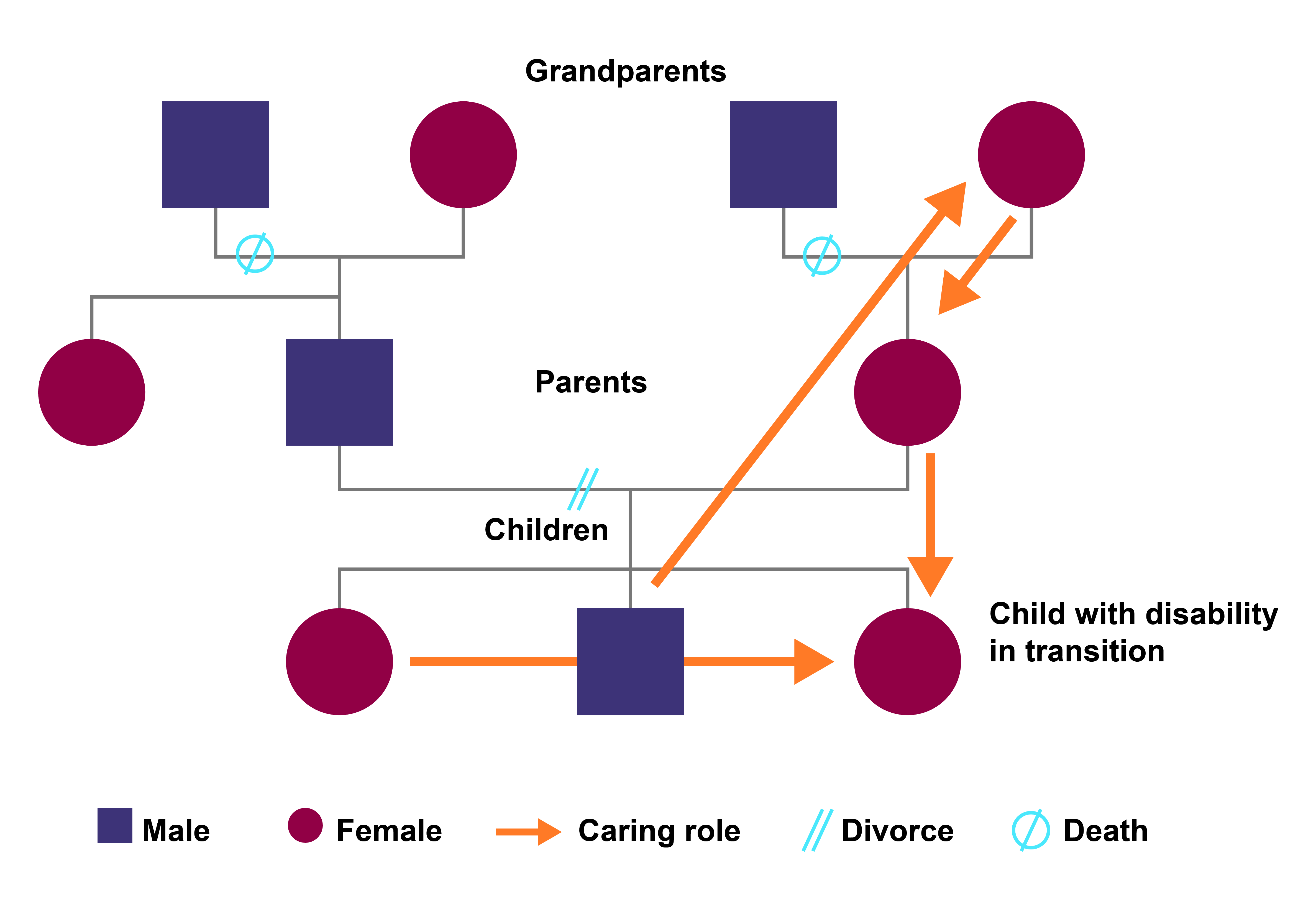
3. Genogram
This is a sample genogram from the Social Care Institute for Excellence (SCIE), that can be adapted to show family and caring relationships.
4. Identifying your support network
This is an example from Northamptonshire Carers of a diagram used to help people identify their support network.
Look at the diagram below and identify those people in your life who can provide various types of support to you in times of need. Put your name into the centre box and the names of the people into outer boxes. Underneath their names try to identify what you can talk to them about and how this may help you.

5. My emergency crisis plan
The hand is used by Northamptonshire Carers to help people identify those people i.e. relatives, friends, neighbours, professionals, services, organisations that could be called upon quickly to help in a crisis situation. It could also be used to help people to think about their day-to-day support network.
My Emergency/Crisis Plan
Look at the diagram of the hand below and try to identify those people i.e. Relatives, friends, neighbours, professionals, services, organisations that could be called upon quickly to help in a crisis situation. This may be the result of a sudden illness or feeling that you are unable to cope at present, with your caring role. Place your immediate contact person in the centre of the hand and for each of the fingers and thumb, write down the people you can contact, what support/help they can provide and their contact details. This can be placed somewhere that you can access easily and quickly in the event of an emergency/crisis occurring.

Further reading and resources
Children and Families Act and Care Act 2014 – 10 years on for young carers and young adult carers
Whole Family Pathway - A resource for practitioners
Shaping our future - Improving Assessment and Support for Young Carers’ Transition into Adulthood
Young Carers’ Transition to Adulthood: A pathway for all practitioners
Young Carers Needs Assessments – Checklist
West Yorkshire Carers Hospital Discharge Toolkit
Resources for working with younger carers
London Toolkit on Carers & Hospital Discharge
MindMate - helps young people in Leeds find out more about being a young carer and how they can care for themselves
Carers Trust dedicated webpage for ‘No Wrong Doors for Young Carers’ MOU
Carers Trust set of training resources to support professionals identify and support young carers
Carers Trust Young Carer Mental Health Toolkit
Carers Trust Identification Practice of Young Carers in England – Review, Tips and Tools
Young Carer Support App for Android phones
Young Carer Support App for Apple phones