Paul Clarke:
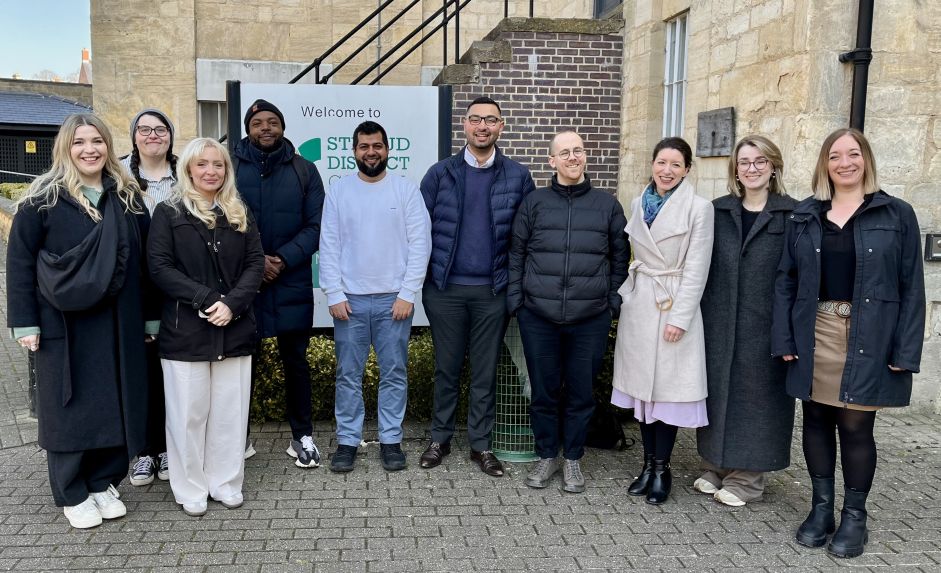
Today we’re really fortunate to be in Stroud in Gloucestershire. Stroud is a fantastic district council and it’s always on the front foot. The area is facing the biggest local government reorganisation since 1974, as a council.
Hannah Barton:
We have a set of community engagement principles that were prepared last year, and what we’d really like to hear from the contestants, are how they think we should go about embedding these. Do they think that we should go further with what we’ve already put together? Do they have any examples of how we can carry them out, and how can we really start working more on co-production, with our community as well.
Rebecca Dentith:
We’ve just arrived with Stroud District Council, and we’ve had a fantastic overview, helping us understand the strategy, what they’re working towards, and really understanding the culture that they’re wanting to embed.
Shohum Dave:
Stroud District Council are doing a lot to engage their community. We’re having a bit of a challenge to understand exactly where those gaps are, but we’re trying to come up with solutions that would not only work for today, but when they also go for the local government reorganisation as well, and how they can keep the identity of Stroud District within that too.
Mike Campbell:
We spoke to Srah Clark, who wrote the Community Engagement Principles. I learned about where they came from, what they’re trying to achieve through the principles, and some of the challenges they’ve had in embedding them.
Aoife O’Gorman:
Just come out of a meeting with Laura, who runs one of the community hubs. She’s really passionate about what she does. We learned a lot, particularly around some of the challenges that they face, especially around funding and some hard to reach demographics, particularly when there are individuals who have cross-cutting needs.
Adeel Hussain:
Within the two stakeholder meetings, I think what the strong message I’ve walked away with is, there is so much rich data and lived experience, that is being gathered by community organisations, and I think one of the key aims is to establish how that data and lived experience can feed up in to the organisation.
Michael Barrett:
The cohort have now met a series of stakeholders in meetings this afternoon, and now they’re about to embark on a walking trail, through Stroud, which will connect all of its historical landmarks. Team captains Shohum and Rebecca are both doing really well. The teams have a lot of experience around community engagement, and as local government officers, this is a clear passion for all of them, and they’re really bringing that to this challenge.
Shohum Dave:
Team Visionaries here, everyone give a cheer. Whoop, whoop. How’s everyone feeling?
Angelo Da Costa:
Good.
Mike Campbell:
Pretty good.
Aoife O’Gorman:
Quite full.
Shohum Dave:
Yes.
Mike Campbell:
Well led.
Shohum Dave:
Yeah. We’ve just come back from dinner, gonna crack on with the report, and presentation and then hopefully good luck for tomorrow.
Rebecca Dentith:
It's been a fantastic day getting to meet the different stakeholders across the council and really understand what customer engagement means to them and what Stroud District Council are already working toward. I’m really happy with what we’re putting forward, and can’t wait to present it back to everyone tomorrow.
Harriet Vitty:
It's day two and last night we went on a historic walking tour of Stroud. It definitely exemplified Stroud District Council’s, desire to innovatively engage with its community. There are different communities, with very distinct identities, and they are celebrating each communities difference, and looking at ways that they can engage with them most effectively.
Angelo Da Costa:
First, we were taken to Blackboy Clock, and it was fascinating because I wasn’t really aware of the history, surrounding anti-slavery and equality that Stroud District Council focuses on. As part of the of the walk yesterday, we also saw the Freedom Arch Monument. There was this miniature of two hands in chains, and I thought that was fascinating. Makes you feel close to those people. It was very educational, humbling as well.
Jess Finnin:
I think it’s really interesting how Stroud have been able to address their history, and been able to use the community in that. It’s really easy to prescribe values and ideas, and actually that doesn’t always work for the communities that you’re working with. So Stroud being able to bring the community along with them on that journey is brilliant.
Virginia Ponton:
Challenge three is the halfway mark of the programme, and at this point they are really used to working together. Whilst the topics are still challenging for them, you can see that their confidence has grown in how they’re approaching the tasks. They’re bring their diverse skills from their roles at their home councils, together with the learning and development they’ve had as a cohort and applying that to Stroud. Which is what this leadership programme is all about.
Amy Lipley:
In the challenge more generally I can really feel myself growing as an officer. Learning from all these different councils has been really, really helpful, and I’ve been bringing is back to Basildon, already. But I think things like my presenting skills are getting ten times better. Shohum as captain has been inspiring, to see his confidence grow and to really see him step in to the role of the leader, is something that I will be taking inspiration from.
Helen Potter:
I’m really enjoying looking at other councils, visiting them, seeing what’s going on, seeing the different ways that people are working, and observing different leadership styles and different ways of managing.
Shohum Dave:
Team Visionaries are proposing, a re-evaluation, of Stroud District Council’s community engagement approach, by reimagining the ten principles into three coherent stages. First, create. Second, collaborate. Third consolidate. We want to embed community engagement throughout the council, to make sure it’s everyone’s roles, not just a team or in a silo.
Rebecca Dentith:
Team Ascend’s proposal is that we look to refine the existing work, on the community engagement principles to four core areas, we want to listen, learn, involve and empower, community hubs, residents and officers within the organisation, so that there can be a more embedded model for co-production.
Cllr Catherine Braun:
We chose team Ascend as the winning team. Both teams were excellent, but team Ascend did a really compelling presentation. They used an element of drama when they came in and gave us a case study. They’d clearly understood some of the different areas across our district and brought in some humour as well. And that was really engaging.
Kathy O’Leary:
There were lots of really good ideas presented by both teams today. How to simplify our terms around community engagement for staff, and how to work together with members to make sure that we are thinking about, community engagement front and centre in every piece of work that we carry out.
Shohum Dave:
The one thing that I think we could have done differently, is perhaps brought in the community voices a bit more, as well as look at the political element more, bringing that local feel to our presentation, which I think that’s what we missed out on.
Rebecca Dentith:
Our success came down to the people on my team. They’ve been absolutely fantastic. Being a captain is so easy when you’ve got people like Harriet, Helen, Jess and Adi. It’s been absolutely amazing, and all comes down to that teamwork.